Liquid Cooling vs Air Cooling: When to Make the Switch
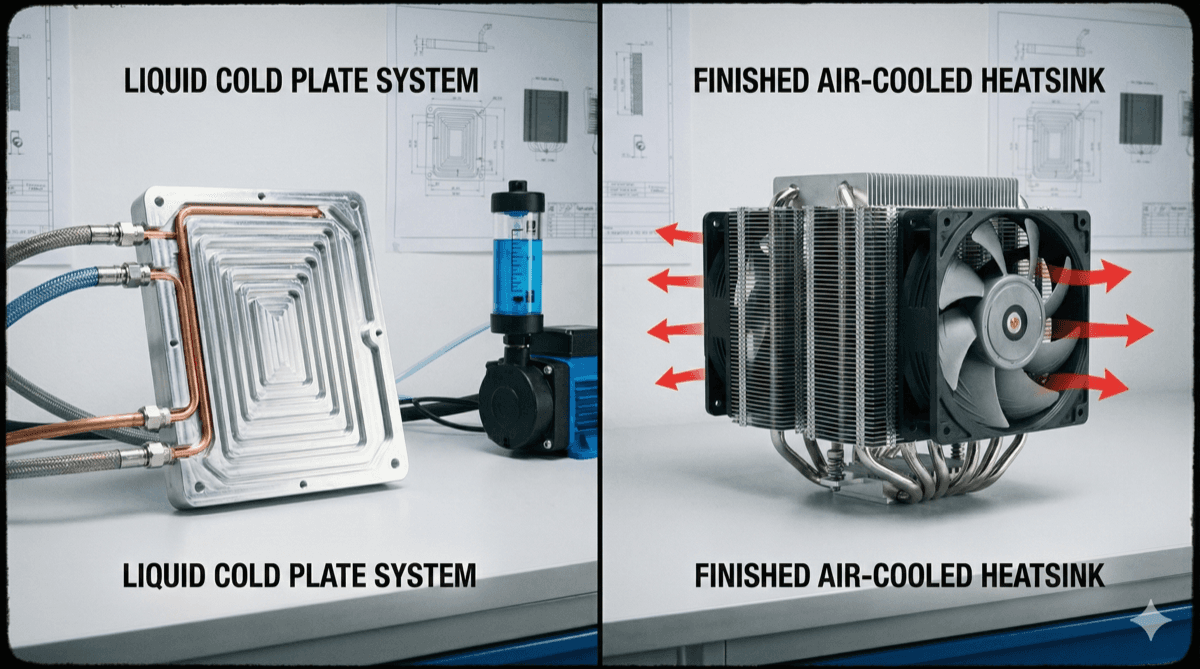
Every power electronics designer eventually faces the air vs. liquid cooling decision. The choice fundamentally shapes product architecture, cost structure, and reliability profile. While there's no universal answer—the right solution depends on your specific requirements—understanding the trade-offs enables informed decisions. This guide examines both approaches to help you choose the optimal cooling strategy for your application.
Air Cooling Fundamentals
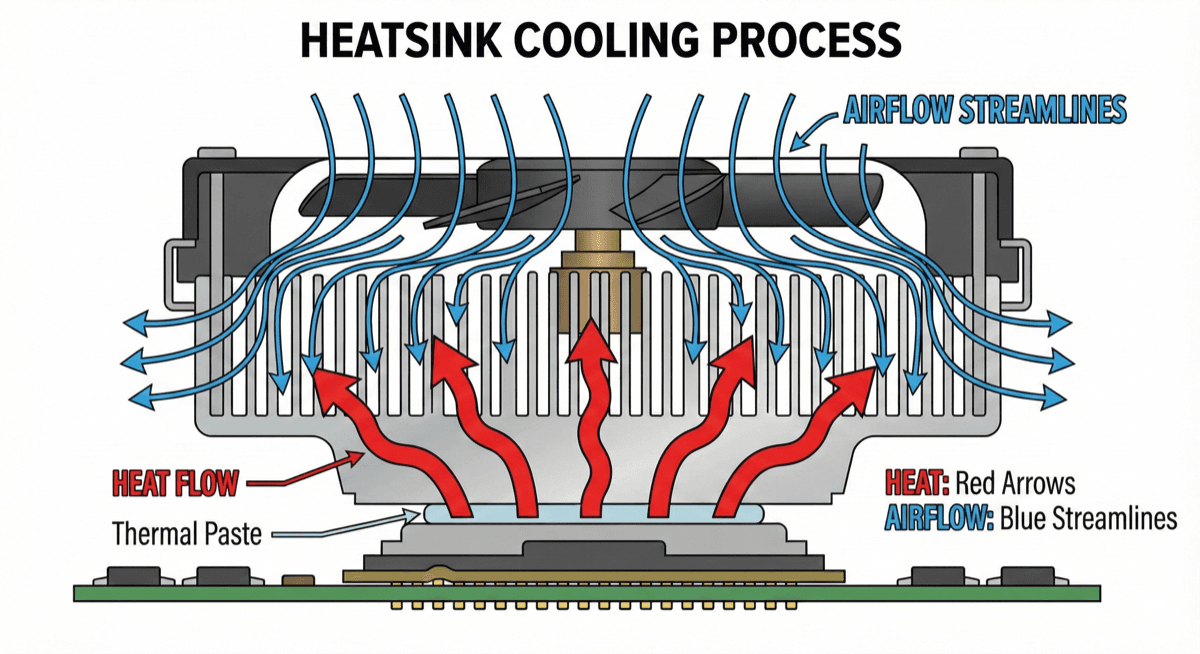
Air cooling transfers heat from components to ambient air through convection. The basic equation governing heat transfer is:
Q = h × A × ΔT
Where Q is heat transfer rate (W), h is the convective heat transfer coefficient (W/m²K), A is the heat transfer surface area (m²), and ΔT is the temperature difference between surface and air (K).
Natural convection (no fans) achieves h values of 5-25 W/m²K. Forced convection with fans increases this to 25-250 W/m²K depending on airflow velocity and heatsink geometry.
The implications are significant: to dissipate 1000W with a 40°C temperature rise using forced air (h=100 W/m²K), you need 0.25 m² of effective heat transfer area. That's a large heatsink—roughly a 250mm cube of well-designed finned aluminum.
Air cooling works well when:
- Power dissipation is moderate (<100-150W per heat source)
- Ambient temperature is relatively low (<40°C)
- Sufficient space exists for heatsinks and airflow
- Long-term reliability of fans is acceptable
- Cost is a primary driver
Liquid Cooling Fundamentals
Liquid cooling uses a pumped fluid (typically water-glycol mixture) to transport heat from components to a remote heat exchanger. The dramatically higher thermal capacity and thermal conductivity of liquids compared to air enables much more efficient heat transfer.
Water has a specific heat capacity of 4.18 kJ/kgK compared to 1.0 kJ/kgK for air—four times higher. More importantly, liquid-cooled cold plates can achieve heat transfer coefficients of 1000-10,000 W/m²K, 10-100 times better than air cooling.
The result: a cold plate the size of a smartphone can remove the same heat as a heatsink the size of a shoebox. This enables power-dense designs impossible with air cooling.
The basic sizing equation for liquid cooling flow rate is:
Q = ṁ × Cp × ΔT
Where Q is heat load (W), ṁ is mass flow rate (kg/s), Cp is specific heat (J/kgK), and ΔT is fluid temperature rise (K).
For example, dissipating 10kW with a 10°C fluid temperature rise requires approximately 0.24 kg/s (14 L/min) of water-glycol flow.
Liquid cooling excels when:
- Power density is high (>100W per heat source)
- Space constraints preclude adequate heatsinking
- Ambient temperatures are extreme
- Precise temperature control is required
- Acoustic noise must be minimized
Performance Comparison
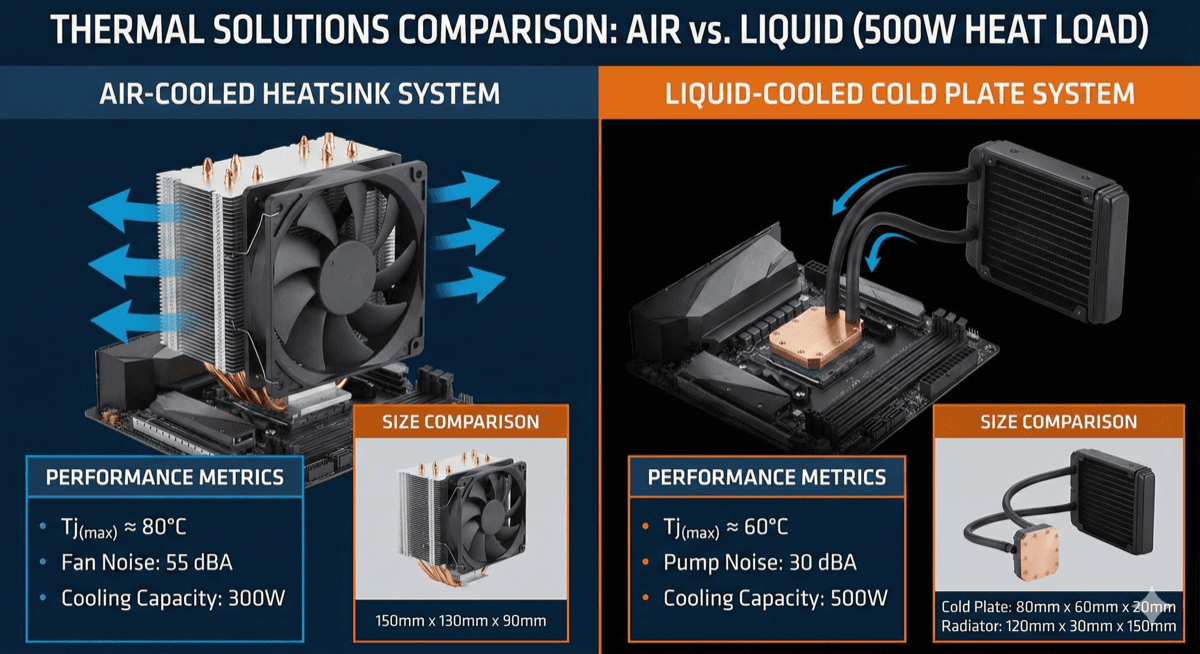
Let's compare the two approaches for a realistic scenario: cooling a 5kW power electronics assembly in a 40°C ambient environment with a maximum component temperature of 100°C.
Air Cooling Approach:
- Available ΔT: 100-40 = 60°C
- Required thermal resistance (junction to ambient): 60/5000 = 0.012°C/W
- Accounting for junction-to-case (0.002°C/W) and TIM (0.002°C/W), heatsink must achieve 0.008°C/W
- This requires a very large heatsink (~300×300×150mm) with high-airflow fans
- Fan power: ~50W
- Total volume: ~15 liters
- Noise: 55-65 dBA
Liquid Cooling Approach:
- Same available ΔT: 60°C
- Cold plate thermal resistance: 0.002-0.005°C/W easily achievable
- Cold plate size: ~150×100×15mm
- Pump power: ~20W
- Heat exchanger volume: ~2 liters
- Total system volume: ~5 liters
- Noise: 35-45 dBA (with proper pump selection)
The liquid system is smaller, quieter, and provides better thermal performance—but at higher initial cost and complexity.
Reliability Considerations
Both cooling approaches have reliability considerations:
Air Cooling Reliability Issues:
- Fans are the most failure-prone component in power electronics. MTTF for typical DC fans ranges from 40,000-100,000 hours at rated conditions, but actual field life is often much shorter due to dust accumulation, bearing wear, and operation at elevated temperatures.
- Heatsink performance degrades as dust accumulates on fins. In dusty industrial environments, heatsinks may require periodic cleaning.
- Thermal cycling causes less stress than liquid systems since components operate at higher temperatures with larger swings.
Liquid Cooling Reliability Issues:
- Leaks are the primary concern. While modern quick-disconnect fittings and O-ring seals are very reliable, the consequence of a coolant leak on power electronics can be catastrophic.
- Pumps also have finite life, typically 20,000-100,000 hours depending on type. Magnetic-drive pumps eliminate shaft seals and improve reliability.
- Coolant maintenance is required—glycol degrades over time and may need periodic replacement.
- Cold plates can develop internal corrosion if coolant chemistry isn't properly maintained.
For most industrial applications with proper design and maintenance, liquid cooling systems achieve comparable or better reliability than air cooling. The key is designing for leak containment and including coolant level/temperature monitoring.
Cost Analysis
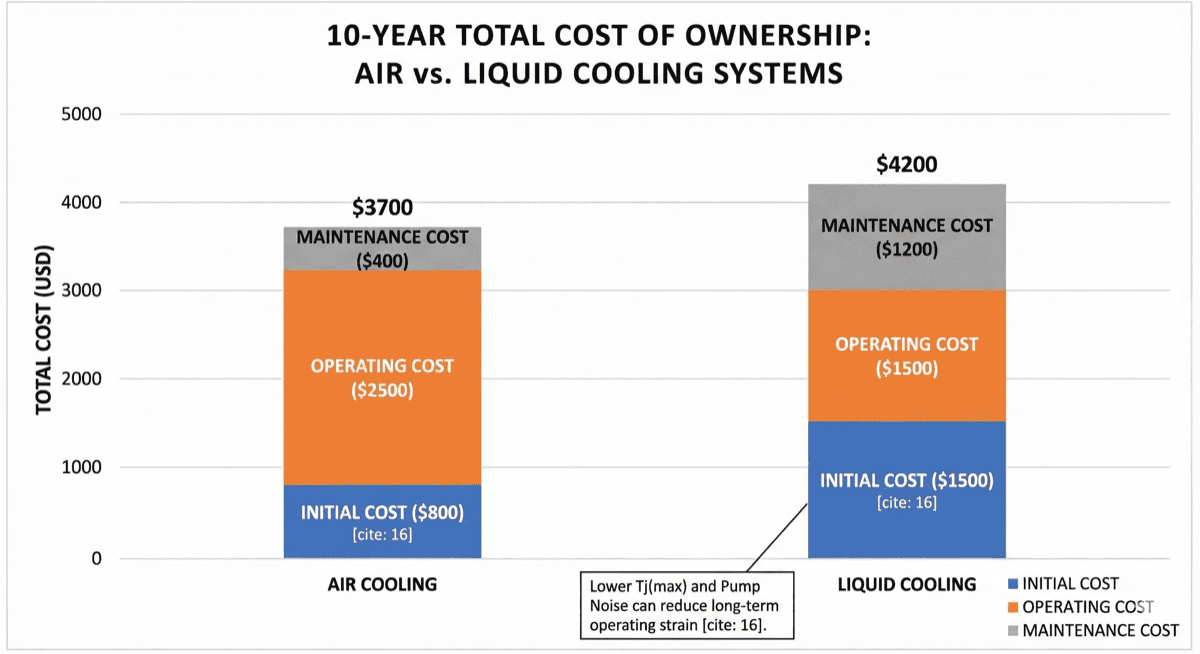
Total cost of ownership includes initial cost, operating cost, and maintenance:
Air Cooling Costs:
- Heatsink: $50-500 depending on size and type
- Fans: $10-100 each
- Installation: Minimal (bolt-on heatsinks)
- Operating cost: Fan power consumption
- Maintenance: Fan replacement every 3-5 years, periodic cleaning
- Typical total system cost: $100-1000
Liquid Cooling Costs:
- Cold plate: $100-500
- Pump: $50-300
- Heat exchanger: $100-500
- Reservoir, tubing, fittings: $50-200
- Installation: More complex, requires plumbing
- Operating cost: Pump power consumption
- Maintenance: Coolant replacement every 2-3 years, occasional pump replacement
- Typical total system cost: $500-2000
Liquid cooling typically costs 2-5x more than air cooling for equivalent heat dissipation capacity. However, when air cooling isn't technically feasible or requires outsized heatsinks, liquid cooling may actually reduce overall system cost by enabling smaller, simpler mechanical packaging.
Making the Decision
Use this framework to guide your cooling technology selection:
Choose Air Cooling When:
- Power dissipation is below 150W per heat source
- Adequate space exists for heatsinks (consider 10-20× the power in cm³)
- Maximum ambient temperature is below 40°C
- Cost is the primary driver
- Fan noise is acceptable for the application
- Product lifetime requirements are modest (5-7 years)
Choose Liquid Cooling When:
- Power density exceeds what air cooling can practically achieve
- Space constraints demand compact cooling solutions
- Operating in high ambient temperatures (>40°C)
- Acoustic performance is critical (e.g., indoor installations)
- Product must operate reliably for 10+ years
- Multiple heat sources benefit from a common cooling loop
Consider Hybrid Approaches:
- Liquid-cooled power stage with air-cooled control electronics
- Heat pipes to spread heat before air-cooled heatsinks
- Two-phase cooling for extreme power densities
Don't forget to validate your choice through thermal simulation and prototype testing before committing to production.