Designing PDUs for Hyperscale AI Datacenters
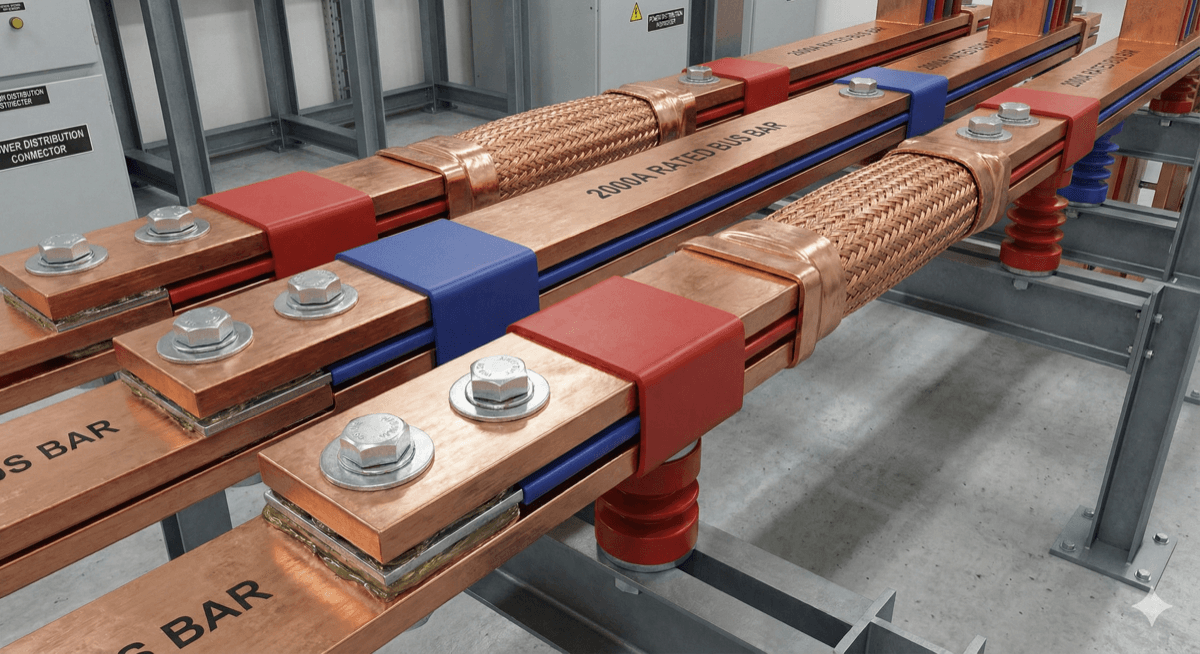
As AI racks push past 100kW, power distribution units (PDUs) face unprecedented thermal and electrical challenges. Traditional 30-42 socket PDUs designed for 10kW racks are wholly inadequate. Hyperscale AI deployments require purpose-built power distribution with massive bus bars, advanced thermal management, and sophisticated monitoring. This article examines the design principles for PDUs capable of supporting next-generation AI infrastructure.
Understanding AI Rack Power Requirements
Before designing a PDU, we must understand what AI infrastructure demands:
Power Levels: A fully populated AI rack with 8 NVIDIA H100 GPUs, networking, and support infrastructure can draw 40-50kW. Next-generation Blackwell systems will push this toward 100kW per rack. Some experimental deployments already exceed 150kW.
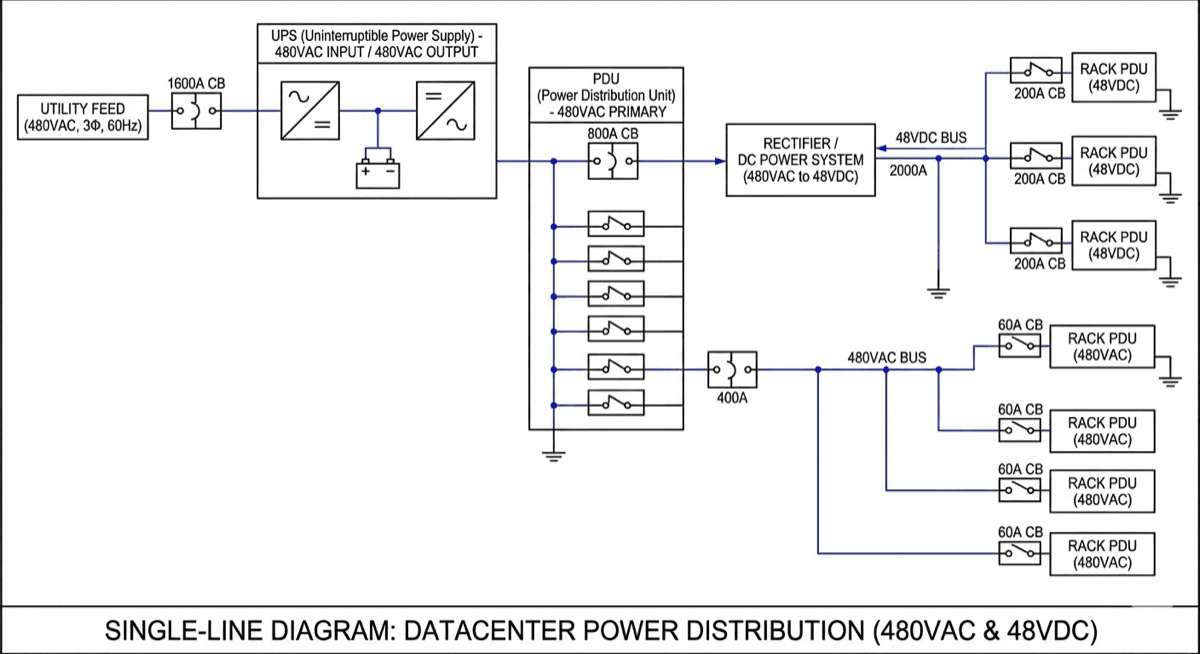
Voltage Standards: Most hyperscalers have transitioned to 48VDC distribution at the rack level, with point-of-load conversion to GPU/CPU voltages. This eliminates one conversion stage and enables higher efficiency. However, some deployments still use 208V or 415V AC.
Current Magnitude: At 48VDC and 100kW, you're looking at over 2000A per rack. Even with 3-phase 208VAC, currents exceed 300A per phase. These currents require substantial conductor cross-sections and robust connections.
Power Quality: AI training is sensitive to power fluctuations. Voltage sags can corrupt training runs that have been running for days. PDUs must provide clean, stable power with minimal voltage drop across all load conditions.
Redundancy: Mission-critical AI infrastructure typically uses 2N or 2N+1 redundant power paths. PDUs must support automatic failover without disrupting operations.
These requirements fundamentally reshape PDU design compared to traditional datacenter applications.
Bus Bar Design for High Current
At hundreds or thousands of amps, bus bar design becomes the central challenge:
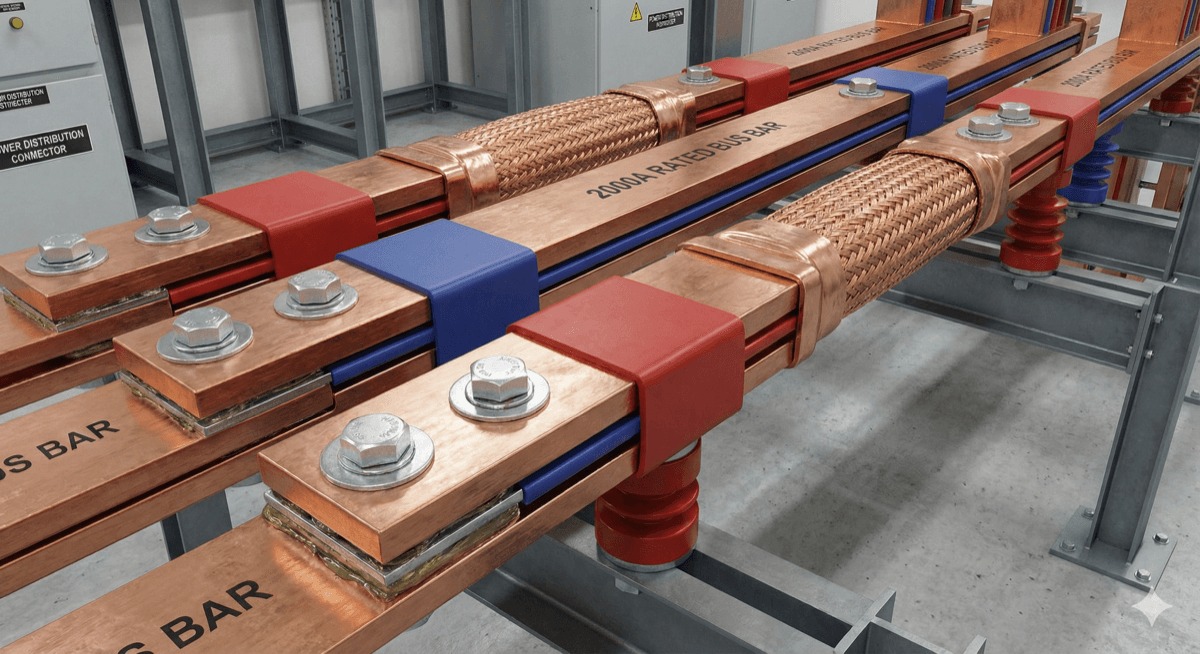
Material Selection: Copper provides the lowest resistivity (1.68 μΩ·cm) and is standard for high-current applications. Aluminum (2.65 μΩ·cm) offers weight and cost advantages but requires larger cross-sections and careful attention to connections.
Cross-Section Sizing: Current capacity depends on allowable temperature rise. At 100A/cm², copper bus bars rise approximately 30°C above ambient in still air. Higher densities require forced cooling or larger conductors. A 2000A bus bar might need 20+ cm² cross-section without active cooling.
Skin Effect: At power frequencies (50/60 Hz), current crowds toward conductor surfaces. For large conductors, this effectively reduces usable cross-section. Hollow or laminated bus bar designs mitigate skin effect.
Thermal Expansion: Copper expands ~17 ppm/°C. A 1-meter bus bar spanning 50°C temperature change expands nearly 1mm. Designs must accommodate this expansion without stressing connections.
Connection Design: The weakest point in any bus bar system is the connections. Bolted connections require proper torque, flat mating surfaces, and appropriate fastener materials (typically plated steel or stainless). Contact resistance at a single poor connection can generate substantial localized heating.
Insulation: High-voltage bus bars (480VAC or above) require careful insulation design. Epoxy coating, heat-shrink tubing, or molded covers prevent accidental contact and flashover.
A 100kW rack PDU might incorporate several hundred grams of copper in bus bars alone. Weight, cost, and thermal management all factor into the design.
Thermal Management of Power Distribution
PDUs dissipate power in proportion to I²R losses. At 2000A through even low-resistance components, heat generation is substantial:
Loss Sources: Major heat sources in a PDU include:
- Main bus bars: 50-200W depending on design
- Circuit breakers: 2-5W per pole at rated current
- Outlet contacts: 0.1-0.5W per connection
- Monitoring electronics: 10-50W
Total losses in a high-power PDU can reach 500-1000W. This heat must be managed to maintain component reliability and safe surface temperatures.
Cooling Approaches:
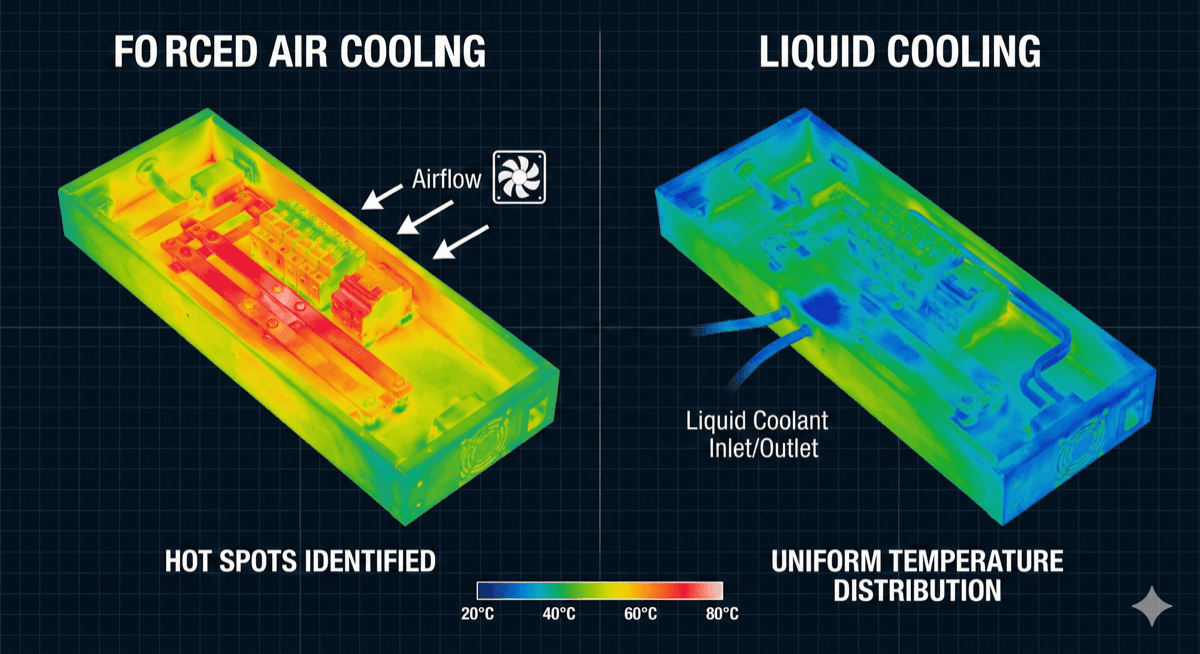
Convection (Passive): For lower-power PDUs, natural convection with adequate ventilation may suffice. Bus bars are oriented vertically to promote airflow. Surface area is maximized with fin structures or corrugated designs.
Forced Air: Fans provide more effective cooling but add noise, power consumption, and failure points. Variable-speed fans that adjust to temperature/load conditions are preferred.
Liquid Cooling: For the highest power densities, liquid-cooled PDUs are emerging. Cold plates attached to major bus bars and semiconductors remove heat directly. This approach enables the most compact designs but adds complexity.
Thermal Design Rules:
- Limit steady-state bus bar temperature to 70°C for long life
- Maintain 10-15°C margin below insulation ratings
- Size conductors for worst-case ambient and load conditions
- Provide thermal protection (temperature cutoffs) for abnormal conditions
Thermal simulation using CFD is essential for validating designs before prototyping. The interaction between electrical current distribution and thermal behavior is complex and not easily predicted analytically.
Protection and Monitoring
High-power AI PDUs require comprehensive protection and visibility:
Overcurrent Protection: Main breakers or fuses must interrupt fault currents that can exceed 50kA in utility-fed systems. Coordination between utility, UPS, and PDU protection ensures faults are cleared at the appropriate level.
Ground Fault Protection: Critical for personnel safety and equipment protection. Ground fault interrupters sized for high continuous loads while still responding quickly to genuine faults.
Arc Flash Considerations: At the power levels in AI facilities, arc flash energy can be extreme. PDU design must consider:
- Incident energy calculations per IEEE 1584
- Labeling requirements
- Safe work procedures
- Remote switching capabilities
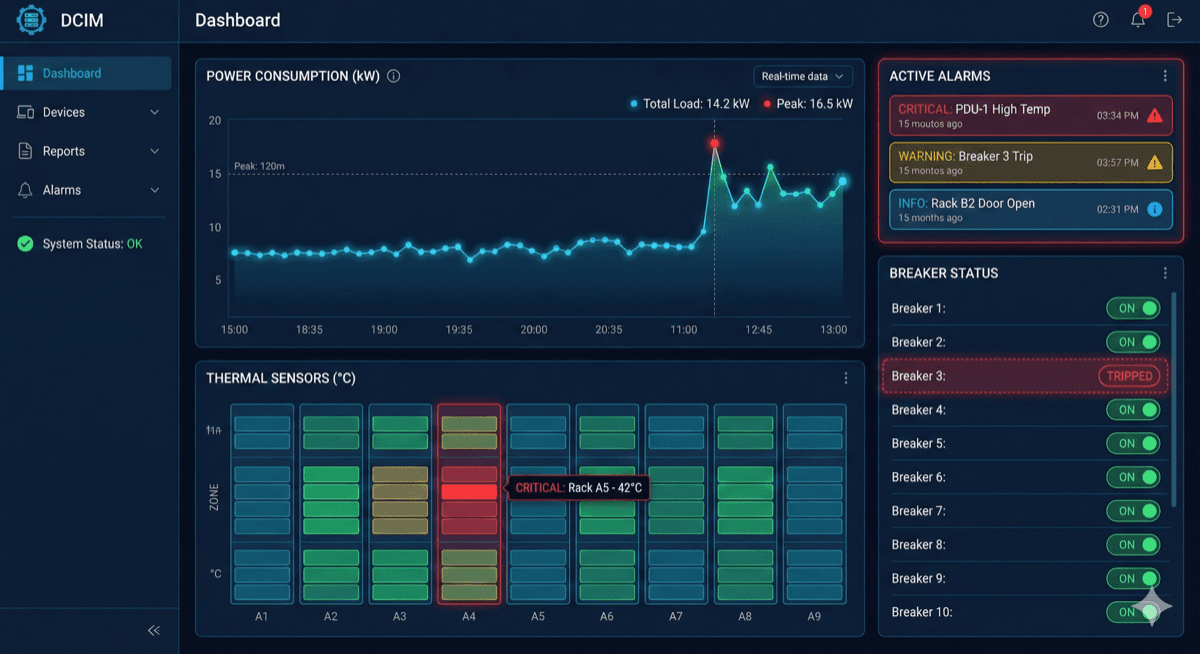
Monitoring Capabilities: Modern PDUs provide extensive telemetry:
- Per-phase and aggregate power, current, voltage
- Power factor and harmonics
- Thermal sensors at critical points
- Door status and environmental monitoring
- Historical data logging for trend analysis
Remote Management: PDUs must integrate with datacenter management systems:
- SNMP, Modbus, or BACnet protocols
- RESTful APIs for modern management platforms
- Secure access with role-based permissions
- Firmware update capabilities
Intelligence: Advanced PDUs incorporate predictive capabilities:
- Load balancing recommendations
- Anomaly detection for failing components
- Capacity planning based on trends
- Integration with workload management systems
These capabilities add cost but are essential for managing facilities at hyperscale. Manual monitoring of thousands of PDUs is impractical.
Design Case Study: 100kW AI Rack PDU
Let's walk through a design concept for a 100kW rack PDU:
Requirements:
- Input: 480VAC 3-phase, 200A service
- Output: 24 × 30A circuits for server PSUs
- Efficiency: >99%
- Redundancy: 2N architecture (dual PDUs per rack)
Physical Design:
- Height: 0U (vertical mount)
- Width: 4" for vertical clearance
- Depth: Full rack depth for cable management
- Weight: ~80 lbs
Electrical Architecture:
- Input: 200A main breaker, 3-phase wye
- Distribution: Copper bus bar rated 250A continuous
- Branch protection: 30A hydraulic-magnetic breakers
- Metering: Per-phase and per-branch power monitoring
- Outlets: 30A IEC 60309 or C19/C20
Thermal Design:
- Bus bars sized for 30°C rise at full load
- Forced air cooling with redundant fans
- Thermal sensors at main bus and all breakers
- Thermal trip if temperature exceeds 90°C
Construction:
- Powder-coated aluminum enclosure for weight savings
- Touch-safe design—no exposed live parts
- Cable management for 24+ heavy-gauge power cords
- Tool-less installation features
Cost: A PDU meeting these specifications costs $5,000-15,000 depending on features and vendor.
This design provides a balance of performance, reliability, and cost for demanding AI applications.
Future Trends in Power Distribution
Power distribution for AI infrastructure continues to evolve:
48VDC Rack Power: The Open Compute Project and hyperscalers are driving adoption of 48VDC power at the rack level. This eliminates AC-DC conversion in server PSUs, improving efficiency by 2-3%. PDUs become DC distribution systems with very different design requirements.
Silicon Carbide (SiC) Devices: SiC MOSFETs and diodes enable higher efficiency rectification and power conversion. As costs decrease, SiC-based PDUs will become more common, especially where power density is critical.
Integrated UPS: Some hyperscalers are moving UPS functionality into the rack or even the server. This changes PDU requirements—they may become simpler distribution devices without conditioning responsibilities.
Lithium-Ion Energy Storage: Replacing lead-acid batteries with lithium-ion improves energy density and reduces maintenance. Integrated battery management becomes a PDU function.
Sustainability Metrics: Energy efficiency regulations and carbon reporting requirements drive interest in PDU-level power measurement accuracy. Precision metering becomes a standard requirement.
Standardization: The Open Compute Project and hyperscaler influence are driving standardization of PDU interfaces, form factors, and capabilities. This benefits smaller operators who can leverage commodity designs.
The 100kW rack is just the beginning. As AI power requirements scale toward the megawatt-per-rack range, power distribution will continue to evolve. Engineers who understand both electrical and thermal aspects of high-power distribution will be essential to this future.