How to Reduce Junction Temperature in MOSFETs and IGBTs
Junction temperature is the critical parameter determining the performance, efficiency, and lifetime of power semiconductors. Every 10°C reduction in junction temperature can double device lifetime. This comprehensive guide covers practical techniques to reduce Tj in MOSFETs and IGBTs, from package selection to system-level thermal optimization.
Understanding Junction Temperature
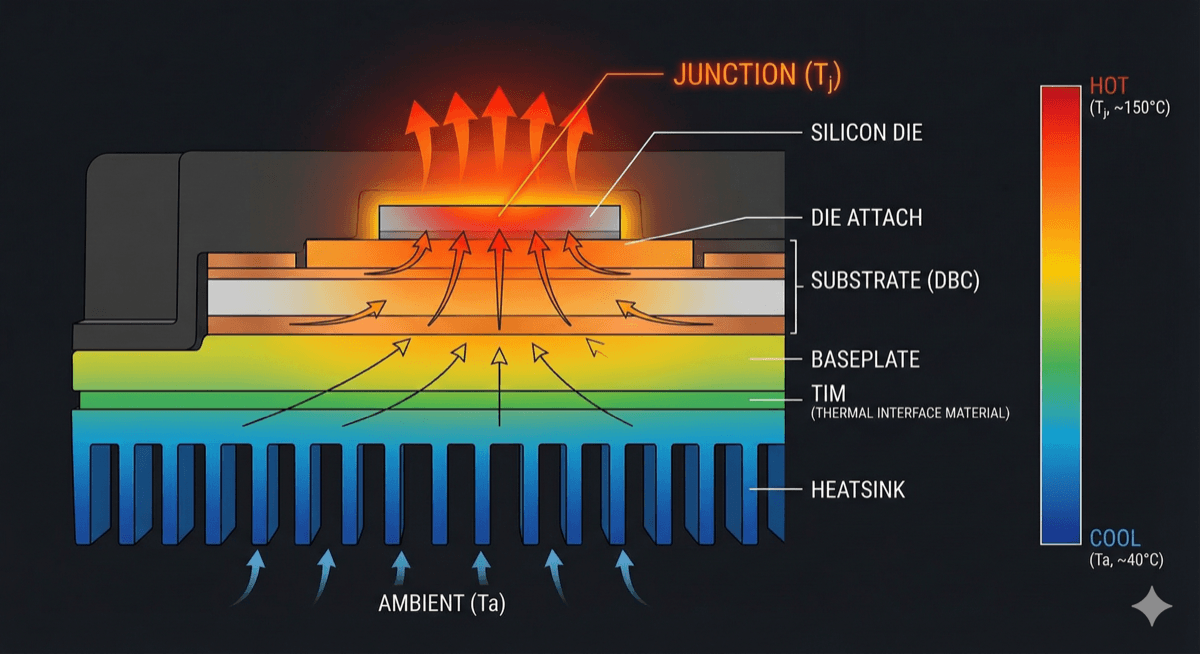
Junction temperature (Tj) is the temperature at the semiconductor die where current flows and power is dissipated. It directly affects:
Performance:
- On-resistance (RDS(on)) increases ~0.4%/°C for MOSFETs
- Switching losses increase with temperature
- Safe Operating Area (SOA) shrinks at higher Tj
Reliability:
- Every 10°C reduction approximately doubles lifetime
- Thermal cycling range determines wire bond fatigue
- High Tj accelerates die attach degradation
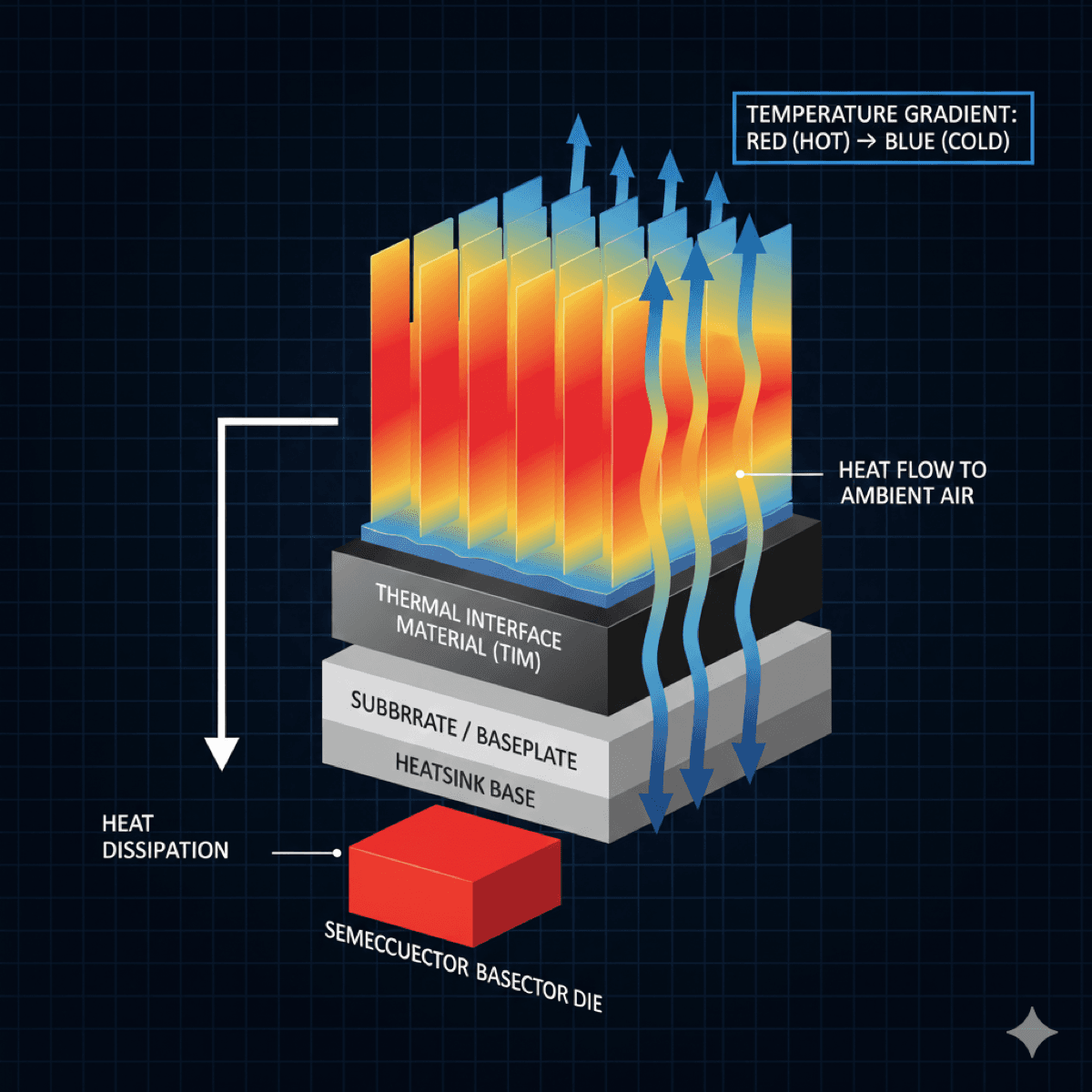
The Thermal Path:
Tj = Ta + P × (Rth_jc + Rth_cs + Rth_sa)
Where:
- Ta = Ambient temperature
- P = Power dissipation
- Rth_jc = Junction-to-case thermal resistance
- Rth_cs = Case-to-sink (interface) thermal resistance
- Rth_sa = Sink-to-ambient thermal resistance
Calculating Required Thermal Resistance:
Working backwards from maximum Tj: Rth_total = (Tj_max - Ta_max) / P_max
Example:
- Tj_max = 150°C (derated to 125°C for reliability)
- Ta_max = 50°C
- P_max = 100W
Rth_total = (125 - 50) / 100 = 0.75°C/W
This total must be divided among junction-case, interface, and heatsink.
Package Selection Strategies
Package choice fundamentally limits achievable Rth_jc. Selecting the right package is the first step in thermal optimization.
Common Package Thermal Resistances:
TO-220: 0.5-1.5°C/W TO-247: 0.3-0.7°C/W TO-263 (D2PAK): 1-3°C/W TO-252 (DPAK): 3-8°C/W SOT-223: 40-60°C/W QFN: 2-10°C/W (varies widely)
Power Module Advantages:
For high-power applications (>100W per switch), power modules offer:
- Lower Rth_jc (0.05-0.2°C/W)
- Baseplate for direct heatsink mounting
- Integrated gate drivers (some)
- Parallel die for current sharing
Popular module formats:
- Econopack (standard industrial)
- SEMIKRON/Infineon modules
- Semisouth/CREE SiC modules
Package Selection Guidelines:
< 50W per device: → Discrete packages (TO-247, TO-220) → Good airflow around package
50-300W per device: → High-power discretes (TO-264, SOT-227) → Or small power modules
300W per device: → Power modules required → Consider liquid cooling
Advanced Packages:
Double-Sided Cooling:
- Removes heat from both sides of die
- Can halve effective Rth_jc
- Requires specialized heatsink design
Embedded Die:
- Die embedded in PCB substrate
- Direct thermal path through board
- Good for high-density designs
Direct Bonded Copper (DBC):
- Die mounted on ceramic substrate with copper
- Excellent thermal and electrical isolation
- Standard for high-power modules
Reducing Power Dissipation
The most effective way to reduce Tj is to reduce power dissipation. Even small reductions compound across the thermal stack.
Conduction Losses:
P_cond = I²RMS × RDS(on) (MOSFETs) P_cond = I_avg × VCE(sat) (IGBTs)
Reduction strategies:
- Use lower RDS(on) devices (often larger die)
- Parallel multiple devices
- Reduce current through circuit design
- Select SiC MOSFETs (lower RDS(on) at temp)
Switching Losses:
P_sw = 0.5 × V × I × (t_rise + t_fall) × f_sw
Reduction strategies:
- Reduce switching frequency (if ripple permits)
- Use faster devices (SiC, GaN)
- Implement soft switching (ZVS, ZCS)
- Optimize gate drive (faster, but watch EMI)
Gate Drive Losses:
P_gate = Qg × Vgs × f_sw
Often small compared to switching losses, but matters at high frequency.
Trade-offs:
Lower RDS(on) → Higher capacitance → Higher switching losses Faster switching → Lower losses → Higher EMI
Finding the optimum requires system-level analysis.
SiC vs Silicon:
SiC MOSFETs offer:
- Lower RDS(on) per die area
- RDS(on) increases less with temperature
- Higher switching speed capability
- Higher operating temperature (175°C+)
Consider SiC when:
- Operating at high temperature
- High switching frequency (>50kHz)
- Efficiency is paramount
- Premium cost is acceptable

Heatsink Optimization
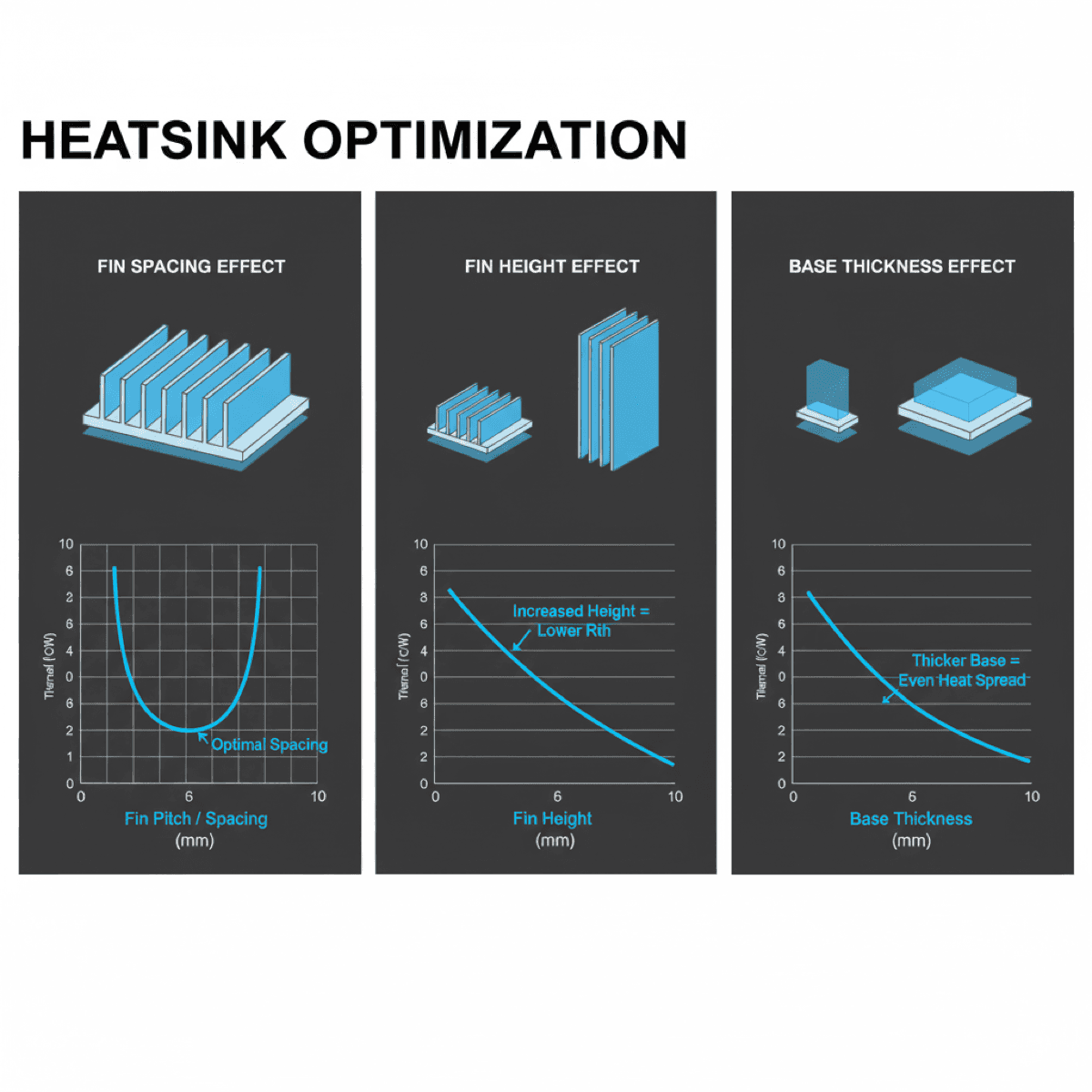
With package and power determined, heatsink design must provide sufficient Rth_sa.
Natural Convection Heatsinks:
Typical Rth_sa: 1-10°C/W depending on size
Optimization parameters:
- Fin height: Taller = better (diminishing returns above 50mm)
- Fin spacing: 6-10mm for natural convection
- Fin thickness: 1-2mm typical
- Base thickness: Thicker spreads heat better
Rules of thumb:
- Rth ∝ 1/√(Surface area)
- Vertical orientation 15-20% better than horizontal
- Black anodize improves radiation by 20-30%
Forced Air Heatsinks:
Typical Rth_sa: 0.1-1°C/W
Optimization parameters:
- Airflow velocity: Higher = better (watch pressure drop)
- Fin spacing: 1.5-3mm for forced air
- Fin aspect ratio: Height/spacing = 10-20 typical
- Bypass: Prevent air from going around heatsink
Performance scaling:
- Rth ∝ 1/velocity^0.5 to 0.8
- Doubling airflow cuts Rth by ~30-40%
Liquid Cooling:
Typical Rth_sa: 0.01-0.1°C/W (effectively Rth_sc for cold plate)
When to use:
- Power density > 50W/cm²
- Ambient > 40°C
- Multiple devices in close proximity
- Enclosure is sealed
Cold plate design parameters:
- Channel geometry (parallel, serpentine, pin-fin)
- Coolant flow rate
- Coolant type (water, water-glycol, dielectric)
- Inlet/outlet locations
Heatsink Material Selection:
Aluminum (6063-T5):
- k = 200 W/mK
- Density: 2.7 g/cm³
- Cost-effective, easy to extrude
Copper:
- k = 390 W/mK
- Density: 8.9 g/cm³
- 2× thermal performance, 3× weight, 3× cost
Hybrid:
- Copper base for spreading
- Aluminum fins for surface area
- Best of both worlds
Interface Optimization
The case-to-sink interface often limits thermal performance. Proper TIM selection and application are critical.
Interface Thermal Resistance:
Rth_cs = t / (k × A) + Rcontact
Where:
- t = TIM thickness
- k = TIM thermal conductivity
- A = Contact area
- Rcontact = Surface contact resistance
Minimizing Rth_cs:
-
Reduce bond line thickness:
- Use machined surfaces (Ra < 1.6μm)
- Apply appropriate mounting pressure
- Consider phase change materials
-
Increase effective conductivity:
- Select higher-k TIM
- But diminishing returns above 5-10 W/mK
- Contact resistance often dominates
-
Increase contact area:
- Ensure full footprint contact
- Avoid warped heatsink surfaces
- Use compliant TIMs for imperfect surfaces
Typical Interface Values:
Thermal grease (3 W/mK, 50μm): 0.02-0.05°C/W per cm² Gap pad (3 W/mK, 0.5mm): 0.15-0.25°C/W per cm² Phase change (2 W/mK, 75μm): 0.03-0.08°C/W per cm²
Mounting Pressure:
Most TIMs require 50-200 psi for optimal performance. Use:
- Calibrated torque on fasteners
- Spring washers for consistent preload
- Belleville washers for high force in small space
Interface Area Considerations:
Larger package → More interface area → Lower Rth_cs But: Package footprint may not equal thermal footprint
For modules with multiple die:
- Consider die locations within package
- Account for spreading resistance
- TIM must cover all die locations
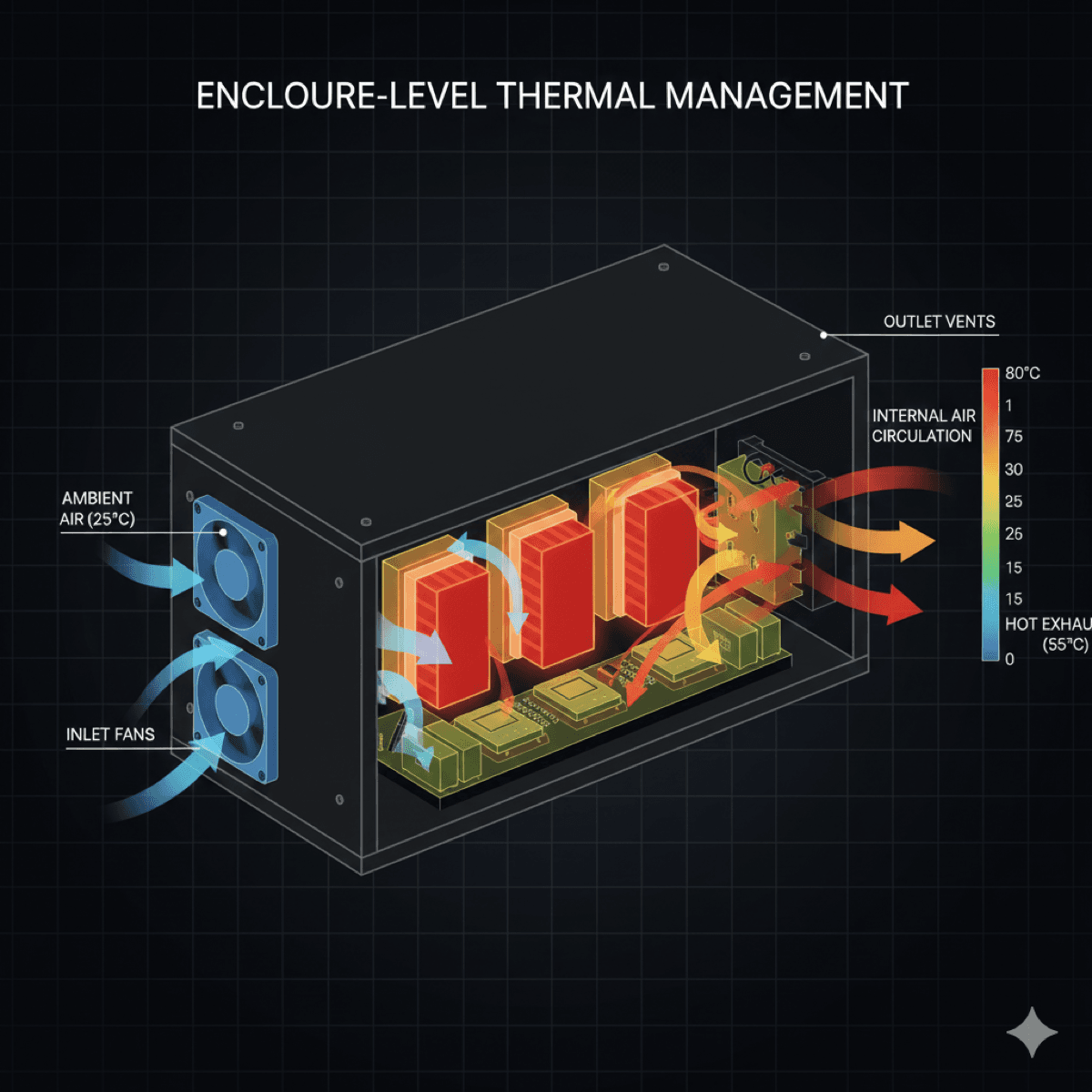
System-Level Thermal Management
Beyond component-level optimization, system design significantly impacts junction temperatures.
Enclosure Airflow:
- Position inlet vents low, outlet high (natural convection)
- Avoid recirculation of exhaust air
- Separate hot and cold zones
- Provide adequate clearance around heatsinks
Component Placement:
- Hottest components near exhaust
- Temperature-sensitive components upstream
- Maintain minimum spacing between heat sources
- Consider thermal coupling between devices
Ambient Temperature Management:
Every 1°C ambient reduction = 1°C Tj reduction
Strategies:
- Locate equipment in shaded areas
- Use light-colored enclosures
- Provide enclosure ventilation
- Consider active cooling of enclosure
Power Derating:
Operating at reduced power reduces Tj:
- At 80% load, losses reduce ~35%
- Significant lifetime improvement
- Consider oversizing power stage
Thermal Transients:
For pulsed loads, thermal mass matters:
Zth = f(pulse width, duty cycle)
Short pulses (<100ms) use much lower effective Rth Allows higher peak power than DC capability
Monitoring and Protection:
- Use NTC thermistors on heatsink
- Implement thermal shutdown
- Consider on-die temperature sensing
- Log temperatures for predictive maintenance
Design Margin:
Always design with margin:
- Target Tj < 80% of Tj_max
- Account for manufacturing variation (±20% Rth)
- Consider end-of-life thermal degradation
- Allow for ambient temperature extremes