How to Optimize PCB Thermal Design for Power Electronics

The printed circuit board plays a crucial role in power electronics thermal management. Beyond its primary function of electrical interconnection, the PCB provides thermal pathways for heat spreading and extraction. Properly designed, a PCB can significantly reduce component temperatures. Poorly designed, it becomes a thermal bottleneck that limits system performance.
PCB as a Thermal Element
Standard FR4 PCB material has thermal conductivity around 0.3 W/mK—roughly 1000 times worse than copper. However, the copper layers within the PCB have excellent thermal conductivity (385 W/mK) and provide the primary heat spreading paths.
Effective PCB thermal design leverages copper strategically:
- Copper planes for lateral heat spreading
- Thermal vias for vertical heat conduction
- Component placement to optimize thermal paths
- Layer stackup selection for thermal performance
The goal is maximizing effective thermal conductivity while meeting electrical requirements. A well-designed power PCB can achieve effective through-plane conductivity of 5-15 W/mK—far better than bare FR4.
Copper Pour Design
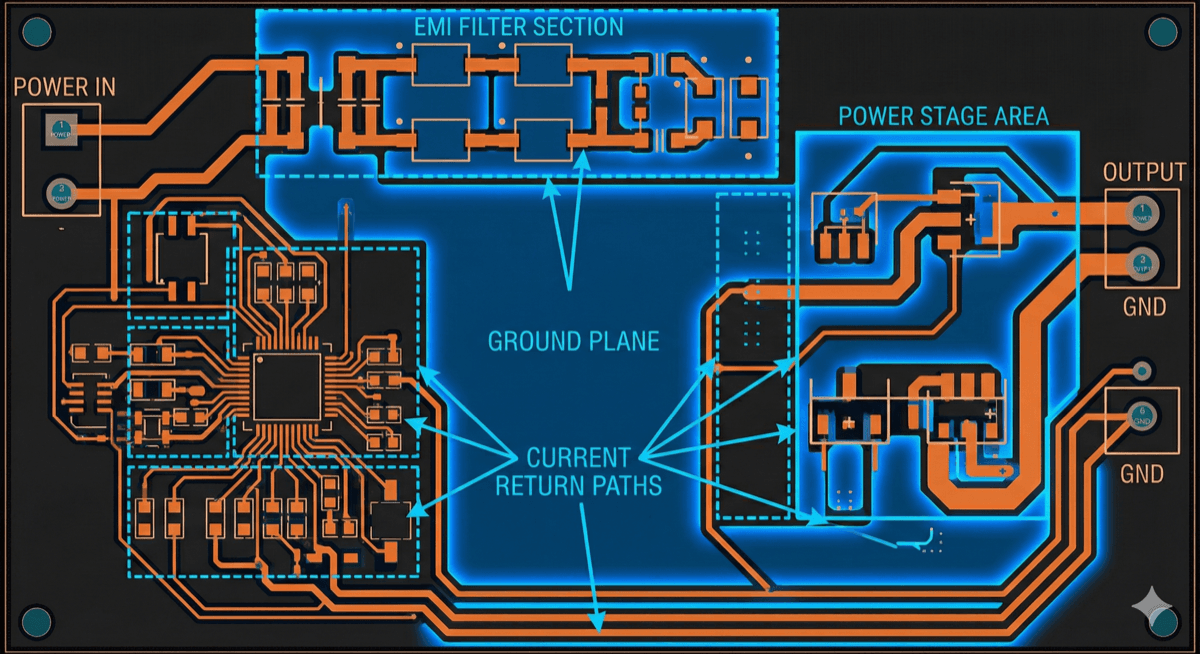
Size and Placement: Copper pours under and around power components should be as large as practical. A general guideline: the pour should extend at least 10-15mm beyond the component footprint in all directions for effective heat spreading.
Thickness: Heavier copper (2 oz/ft² or 70μm vs. standard 1 oz/35μm) significantly improves lateral heat spreading. For power sections, consider 2-4 oz copper on power layers.
Connection to Component: Use the maximum pad size allowed by the component footprint. For power MOSFETs and ICs with thermal pads, connect the thermal pad directly to a large copper pour.
Avoid Thermal Relief: Thermal relief patterns (webbed connections to planes) are useful for soldering standard components but devastating for thermal performance of power devices. Use solid connections for power component thermal pads.
Split Planes Carefully: While separate analog/digital grounds may be needed for EMC, ensure power components have uninterrupted thermal paths to heatsinking copper.
Thermal Via Design
Thermal vias conduct heat vertically through the PCB, connecting component-side copper to inner planes or bottom-side heatsink interfaces.
Via Parameters:
- Diameter: 0.3-0.5mm (larger = lower resistance)
- Pitch: 1.0-1.5mm center-to-center
- Plating: Standard or filled (filled eliminates voids)
- Pattern: Array under thermal pad
Calculating Via Thermal Resistance: For a single via: Rth_via = L / (k_cu × π × (r_o² - r_i²))
Where L is via length, k_cu is copper conductivity, and r_o/r_i are outer/inner radii.
For N vias in parallel: Rth_array = Rth_via / N
Example: 20 vias (0.4mm drill, 25μm plating, 1.6mm length): Rth per via ≈ 80°C/W Rth array ≈ 4°C/W
Filled vs. Open Vias: Filled vias (copper or epoxy filled) eliminate air voids and allow SMT mounting directly over vias. Cost is higher but thermal and assembly benefits often justify it for power applications.
Component Placement Strategy
Thermal Zoning: Separate high-power and temperature-sensitive components. Place hot components (MOSFETs, inductors, rectifiers) together in a dedicated power zone with good thermal paths to heatsinks.
Distance from Board Edges: Allow at least 3-5mm from power components to board edges for heatsink mounting clearance and to prevent edge-related thermal concentration.
Airflow Orientation: When forced-air cooling is used, orient components so airflow reaches hottest components with coolest air. Place sensitive components downstream only if temperature-tolerant.
Height Considerations: Tall components create airflow shadows. Place short power components upstream of tall capacitors or inductors in forced-air designs.
Thermal Coupling: Consider how heat from one component affects neighbors. MOSFETs in parallel should be thermally coupled (close together on shared copper) to promote current sharing.
Layer Stackup Optimization
Power Layer Placement: Place heavy copper power/ground planes on internal layers closest to the power component side. This minimizes via length for thermal conduction.
Thermal Layer: Some designs benefit from a dedicated thermal layer—a plane connected to power device thermal pads that spans the board for maximum heat spreading.
Stackup Example for 4-Layer Power Board:
- Layer 1: Signal/Power traces, 2 oz copper
- Layer 2: Ground plane, 2 oz copper (thermal coupling)
- Layer 3: Power plane, 2 oz copper
- Layer 4: Signal traces, 1 oz copper
Symmetry: Symmetric stackups reduce warpage during reflow and improve thermal uniformity.
Core vs. Prepreg: Standard prepreg between copper layers has lower thermal conductivity than core material. For extreme thermal requirements, consider thermally-enhanced prepreg materials (1.0+ W/mK).
Advanced Techniques
Metal-Core PCBs (MCPCB): For LED drivers and other applications requiring excellent thermal performance, metal-core (typically aluminum) PCBs provide thermal conductivity 10-100x better than FR4. Cost is higher and layer count is typically limited to 2.
Embedded Coin/Heat Sink: A copper slug (coin) can be embedded in the PCB directly under a power component, providing a direct thermal path to a bottom-side heatsink. Common in high-power modules.
Insulated Metal Substrates (IMS): Similar to MCPCB but with optimized dielectric layers for high-voltage isolation while maintaining thermal performance.
Direct Bonded Copper (DBC): Ceramic substrates (alumina or aluminum nitride) with bonded copper layers provide excellent thermal conductivity and high-voltage isolation. Used in power modules and high-reliability applications.
CFD Validation: For critical applications, simulate the PCB thermal performance using CFD tools. Model copper distribution, vias, and component power dissipation to predict temperatures and optimize the layout.