How to Design a Cold Plate for Liquid Cooling Systems
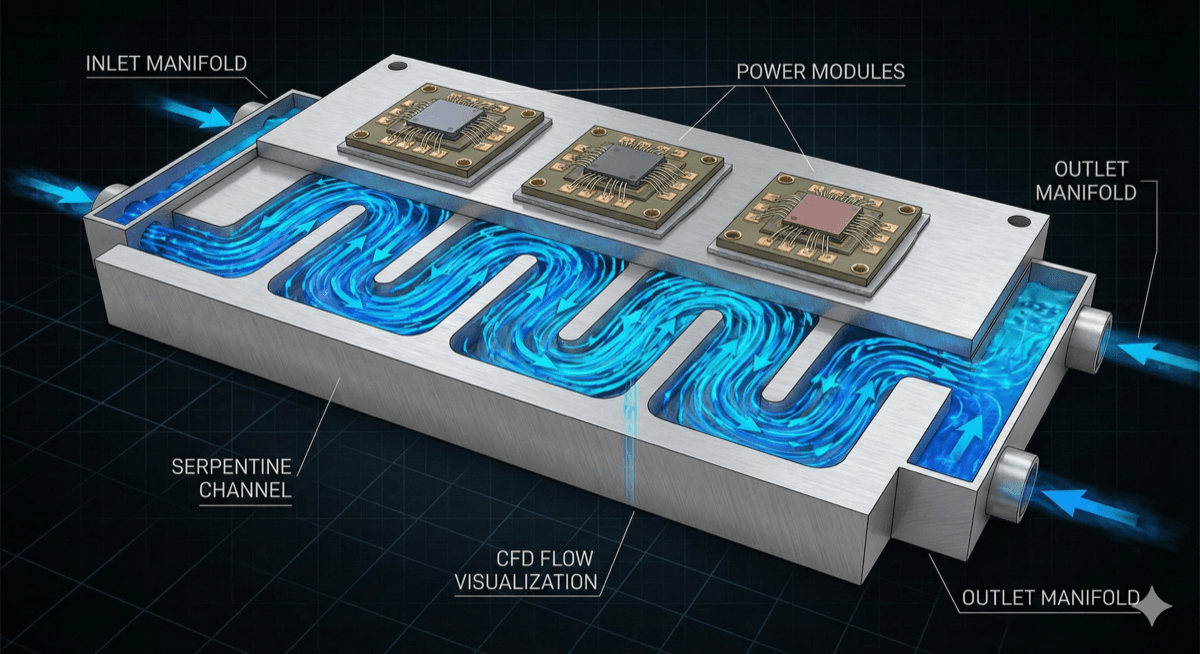
Liquid cold plates provide order-of-magnitude better thermal performance than air cooling, enabling high power densities required by modern power electronics. This guide covers cold plate design fundamentals including channel geometry, material selection, CFD optimization, and system integration considerations for power electronics applications.
When to Choose Liquid Cooling
Liquid cooling adds complexity and cost. Use it when the benefits justify the investment.
Liquid Cooling is Justified When:
Power Density > 30-50 W/cm²: Air cooling becomes impractical at high power densities. Heat sinks grow unreasonably large or require excessive airflow.
Ambient Temperature > 40°C: High ambient reduces the temperature differential available for heat rejection. Liquid cooling maintains capacity at elevated ambient.
Sealed Enclosure Required: IP65+ enclosures prevent ventilation. Liquid cooling moves heat to external radiator or heat exchanger.
Acoustic Constraints: Liquid cooling can achieve equivalent thermal performance with much lower noise than air cooling with high-velocity fans.
Multi-Device Systems: Liquid loops can cool multiple components efficiently, simplifying thermal management.
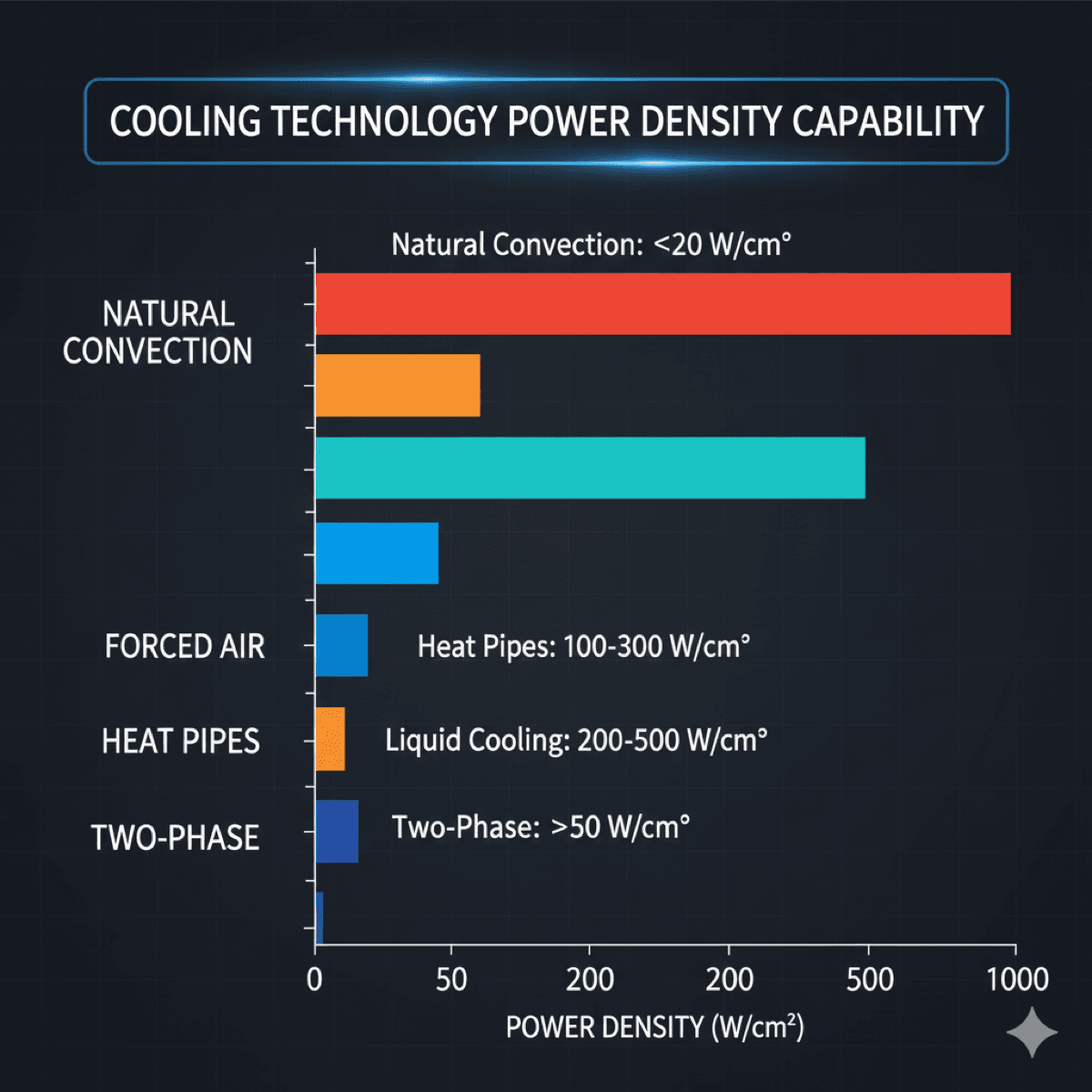
Typical Performance Comparison:
Natural convection heatsink: 1-5 W/cm² Forced air heatsink: 5-20 W/cm² Liquid cold plate: 50-200+ W/cm²
Total Cost of Ownership:
Initial cost higher for liquid, but consider:
- Reduced heatsink size/weight
- Improved reliability (no fans)
- Higher power density = smaller enclosure
- Potential for waste heat recovery
Cold Plate Fundamentals
Cold plates remove heat through forced convection of coolant through internal channels.
Key Performance Equation:
Q = ṁ × Cp × ΔT
Where:
- Q = Heat removed (W)
- ṁ = Mass flow rate (kg/s)
- Cp = Specific heat (J/kg·K)
- ΔT = Coolant temperature rise (°C)
Thermal Resistance Components:
Rth_total = Rth_spreading + Rth_conduction + Rth_convection
Rth_spreading: Heat spreads from source to channels Rth_conduction: Through cold plate material Rth_convection: From channel wall to coolant
Flow Rate Considerations:
Higher flow = Lower Rth (more turbulent, better convection) But: Higher flow = Higher pressure drop = Larger pump
Typical flow rates:
- Small cold plates: 0.5-2 LPM
- Power module cold plates: 2-8 LPM
- Large systems: 10-30 LPM
Pressure Drop:
ΔP ∝ L × v² / Dh
Where:
- L = Channel length
- v = Flow velocity
- Dh = Hydraulic diameter
Design target: 0.5-2 bar pressure drop Higher ΔP = Better cooling but requires larger pump
Coolant Selection:
Water:
- Best heat transfer properties
- Cp = 4180 J/kg·K
- Requires corrosion inhibitors
- Freeze protection needed below 0°C
Water-Glycol (50/50):
- Good freeze protection to -35°C
- Cp = 3300 J/kg·K (20% lower than water)
- Standard for automotive/outdoor
Dielectric Fluids (PAO, Fluorinert):
- Direct contact with electronics possible
- Much lower heat transfer (Cp = 1000-2000 J/kg·K)
- Required for immersion cooling
Channel Geometry Options
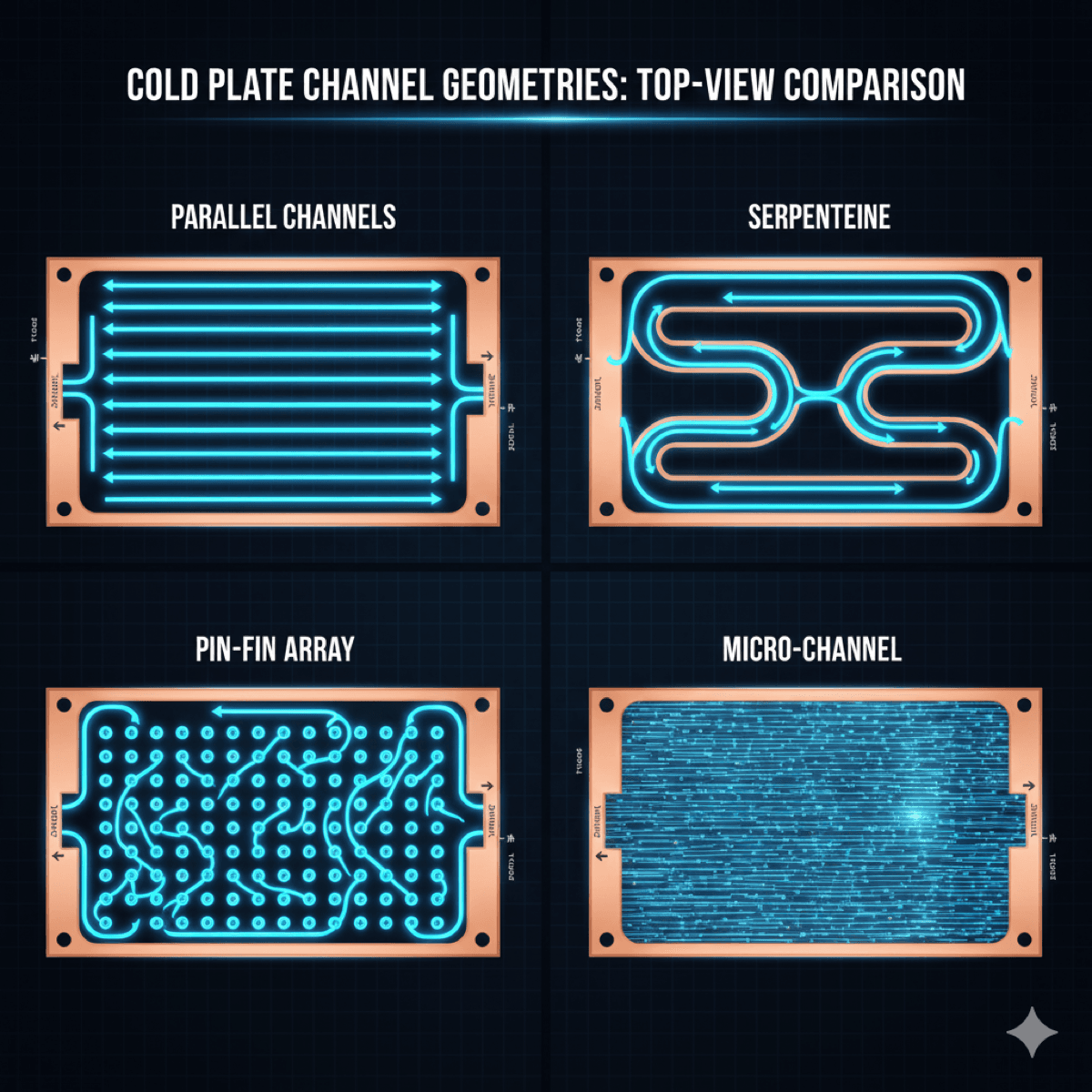
Channel geometry significantly impacts both thermal performance and manufacturability.
Parallel Channels:
Description: Straight channels running parallel across cold plate Advantages:
- Simple to manufacture (gun drilling, extrusion)
- Predictable flow distribution
- Low pressure drop
Disadvantages:
- Flow maldistribution between channels
- Requires careful manifold design
Best for: Large cold plates, moderate power density
Serpentine Channels:
Description: Single continuous channel winding back and forth Advantages:
- Equal flow through entire path
- No flow distribution issues
- Good for uneven heat sources
Disadvantages:
- Higher pressure drop
- Temperature gradient along flow path
Best for: Single/few heat sources, uniform cooling needed
Pin-Fin:
Description: Array of pins in flow cavity Advantages:
- Highest surface area
- Best thermal performance
- Good for very high power density
Disadvantages:
- Highest pressure drop
- More complex to manufacture
- Debris accumulation risk
Best for: High-performance applications, clean coolant systems
Micro-Channels:
Description: Many small channels (<1mm) Advantages:
- Very high heat transfer coefficient
- Compact size
Disadvantages:
- Very high pressure drop
- Clogging risk
- Manufacturing complexity
Best for: Specialized high-power-density applications
Jet Impingement:
Description: Coolant jets impact hot surface directly Advantages:
- Highest local heat transfer
- Excellent for hotspots
Disadvantages:
- Complex manifold design
- High flow rates needed
Best for: Extreme power density, spot cooling
Material Selection
Material choice affects thermal performance, weight, cost, and corrosion resistance.
Aluminum (6061-T6):
Thermal conductivity: 167 W/mK Density: 2.7 g/cm³ Cost: Lowest
Advantages:
- Lightweight
- Easy to machine
- Good for extrusion and casting
- Economical
Disadvantages:
- Galvanic corrosion with copper coolant fittings
- Requires corrosion inhibitors
- Lower conductivity than copper
Best for: General industrial applications, weight-sensitive designs
Copper (C110):
Thermal conductivity: 390 W/mK Density: 8.9 g/cm³ Cost: 3-5× aluminum
Advantages:
- Best thermal conductivity
- Excellent for brazing
- Good corrosion resistance with proper coolant
Disadvantages:
- Heavy
- Expensive
- More difficult to machine
Best for: Highest performance requirements, aerospace
Hybrid (Copper/Aluminum):
Construction: Copper inserts or plates in aluminum body Advantages:
- Copper where needed for spreading
- Aluminum for structure/channels
- Good cost/performance balance
Best for: High-power modules, cost-conscious high performance
Stainless Steel:
Thermal conductivity: 15 W/mK Density: 8.0 g/cm³
Advantages:
- Excellent corrosion resistance
- Compatible with aggressive coolants
Disadvantages:
- Poor thermal conductivity
- Heavy
Best for: Corrosive environments, chemical compatibility
Material Thickness Guidelines:
Base thickness (heat source side): 3-8mm
- Thicker = better spreading from small sources
- Thinner = lighter, faster response
Channel wall thickness: 1-3mm
- Must withstand coolant pressure
- Brazed/welded construction needs adequate material
Cover thickness: 2-4mm
- Structural support for fittings
- Access for manufacturing
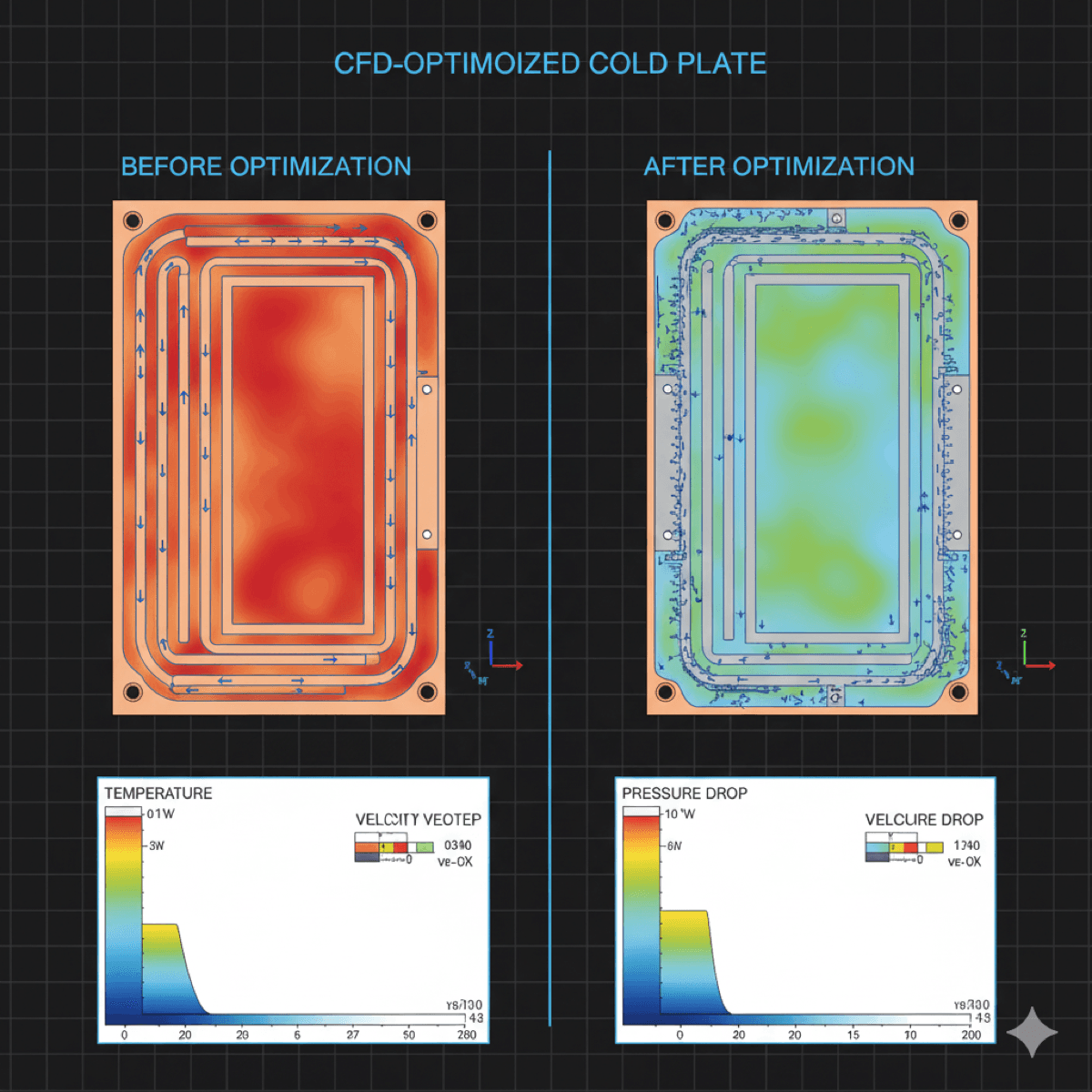
CFD Optimization Process
CFD simulation enables optimization before prototype fabrication.
Step 1: Define Requirements
Inputs needed:
- Heat source locations and power
- Coolant type and properties
- Available flow rate and pressure
- Target thermal resistance
- Size constraints
Step 2: Initial Design
Start with proven geometry:
- Serpentine for single source
- Parallel channels for distributed sources
- Size channels for target pressure drop
Initial sizing:
- Channel width: 3-6mm
- Channel height: 3-10mm
- Wall thickness: 1.5-2mm
- Number of passes: Based on heat source size
Step 3: CFD Model Setup
Boundary conditions:
- Inlet: Mass flow rate and temperature
- Outlet: Pressure outlet
- Heat sources: Heat flux or power
- External: Adiabatic or specified
Mesh requirements:
- 3-5 cells across channel width
- Inflation layers on walls (y+ < 1 for accurate heat transfer)
- Mesh independence study essential
Turbulence model:
- k-epsilon or k-omega SST
- Adequate for most cold plate simulations
Step 4: Optimize
Parameters to vary:
- Channel geometry (width, height, count)
- Flow configuration (series, parallel, mixed)
- Inlet/outlet locations
- Material (if options available)
Optimization goals:
- Minimize maximum temperature
- Minimize temperature gradient
- Minimize pressure drop
- Meet thermal resistance target
Step 5: Validate
Compare simulation to:
- Thermal test data from prototype
- Pressure drop measurements
- Flow visualization if available
Adjust model parameters to match:
- Contact resistances
- Surface roughness
- Inlet/outlet loss coefficients
System Integration
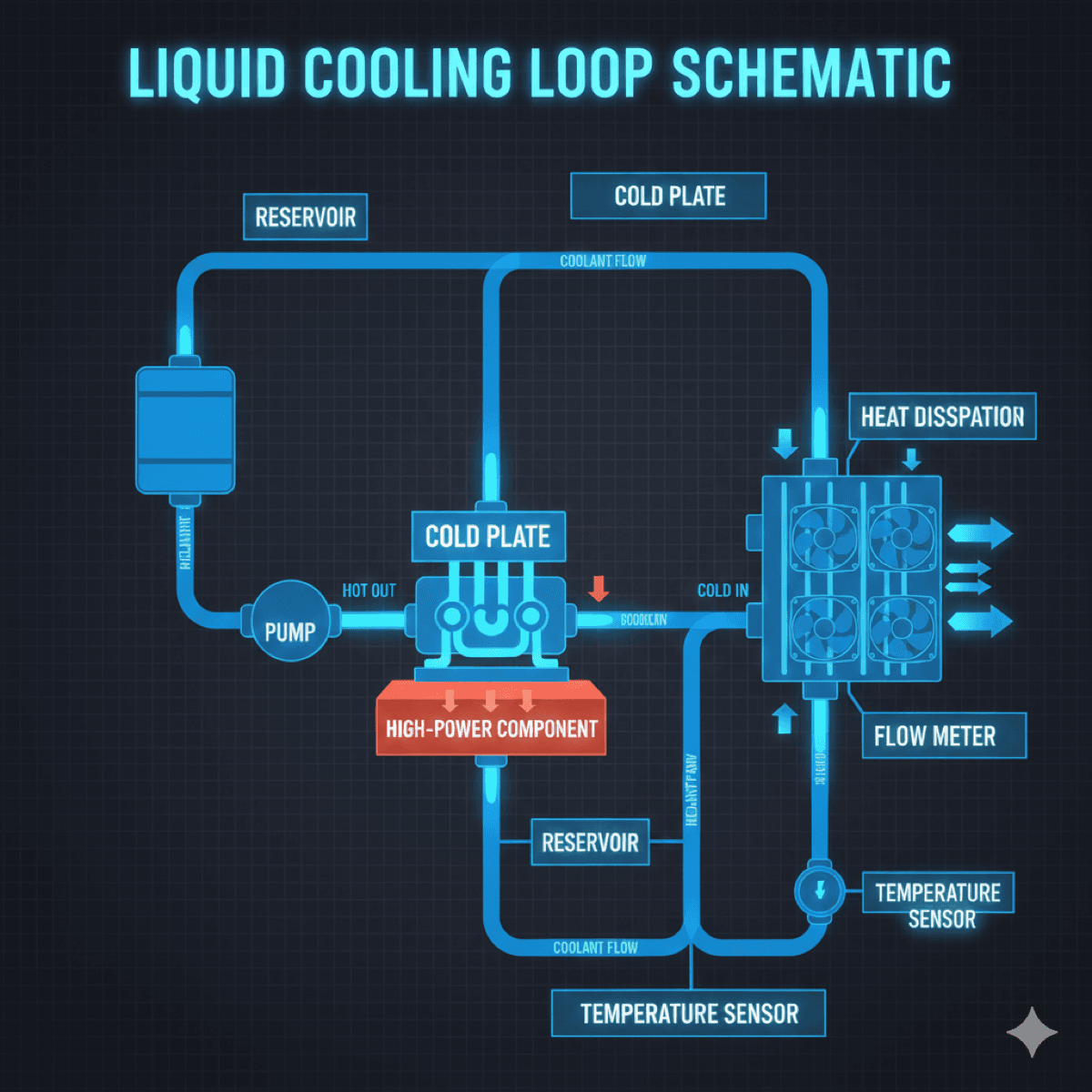
Cold plates must integrate with the complete liquid cooling system.
Pump Selection:
Requirements:
- Flow rate to achieve thermal target
- Pressure rise to overcome system losses
- Reliability for expected lifetime
Types:
- Centrifugal: High flow, moderate pressure
- Positive displacement: Precise flow, higher pressure
- Magnetic drive: Seal-less, improved reliability
Size for:
- Total system pressure drop + 20% margin
- Flow rate requirement
- Worst-case coolant viscosity (cold start)
Heat Rejection:
Options:
- Liquid-to-air radiator (fan-cooled)
- Liquid-to-liquid heat exchanger
- Chiller (active cooling below ambient)
- Dry cooler (outdoor installations)
Sizing:
- Must reject total heat load
- Size for worst-case ambient
- Include approach temperature in calculations
Reservoir/Expansion Tank:
Functions:
- Accommodate thermal expansion
- Remove air from system
- Provide coolant reserve
Sizing:
- 10-20% of total loop volume
- Allow for expansion at maximum temperature
Plumbing:
Considerations:
- Minimize pressure drop
- Avoid air traps
- Allow for thermal expansion
- Include drain points
- Use compatible materials
Fittings:
- Quick-disconnects for serviceability
- Compression fittings for permanent connections
- O-ring face seal for zero-leak
Controls:
Monitor:
- Inlet and outlet coolant temperatures
- Flow rate (optional)
- Coolant level/pressure
Control:
- Pump speed (for variable flow)
- Fan speed (for radiator)
- Heater (for cold start protection)
Protection:
- Over-temperature shutdown
- Low-flow alarm
- Leak detection
Free Resource: Download our Cold Plate Selection Guide — a 10-page guide on choosing the right cold plate for your application.