Cold Plates vs Heat Sinks: When to Use Each in Power Electronics
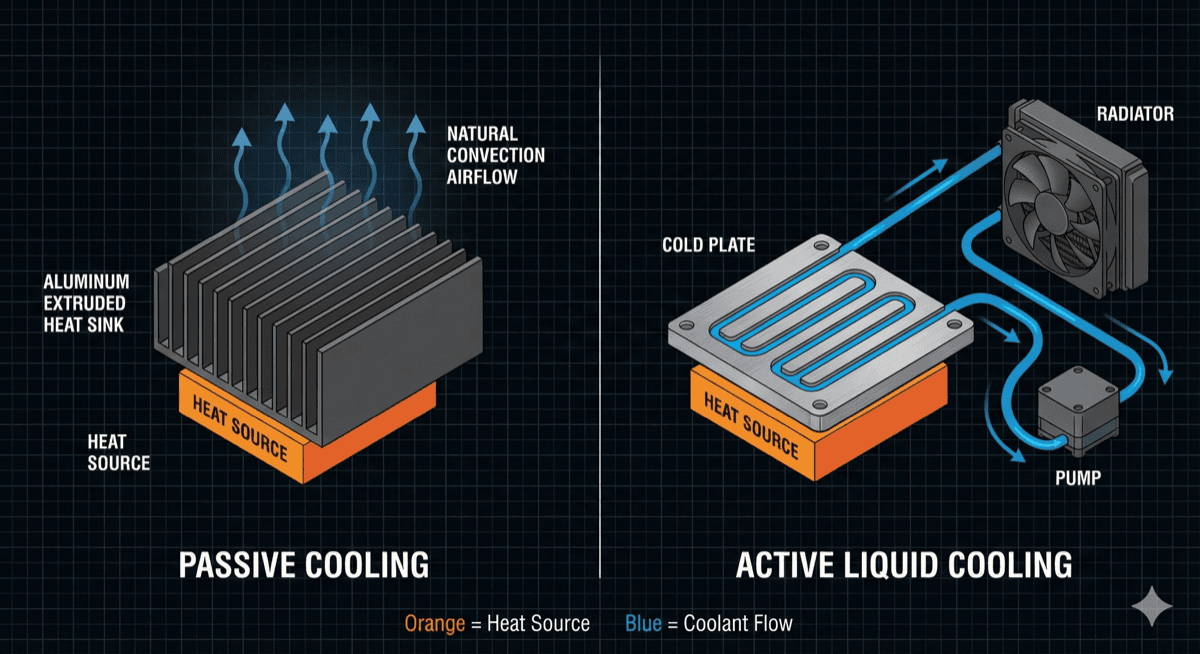
Cold plates and heat sinks represent fundamentally different cooling approaches—liquid versus air convection. Each technology excels in specific applications, and choosing correctly can mean the difference between a reliable, cost-effective design and an over-engineered or underperforming system. This guide helps you make the right choice for your power electronics application.
Technology Overview
Understanding the fundamental differences helps clarify when each technology applies.
Heat Sinks (Air Cooling):
Mechanism: Extended surfaces transfer heat to ambient air Heat transfer coefficient: 5-150 W/m²K Typical thermal resistance: 0.3-5 °C/W Complexity: Low to moderate
Components:
- Heatsink (aluminum or copper)
- Thermal interface material
- Fan (for forced air)
Cold Plates (Liquid Cooling):
Mechanism: Liquid coolant carries heat through internal channels Heat transfer coefficient: 500-10,000 W/m²K Typical thermal resistance: 0.01-0.1 °C/W Complexity: Moderate to high
Components:
- Cold plate
- Pump
- Reservoir
- Heat exchanger/radiator
- Plumbing and fittings
- Coolant
Performance Comparison:
Heat flux capability:
- Natural convection heatsink: 0.5-2 W/cm²
- Forced air heatsink: 5-20 W/cm²
- Liquid cold plate: 50-200+ W/cm²
Cold plates handle 10-100× higher heat fluxes.
System Complexity:
Heat sink: Component-level solution Cold plate: System-level solution
Heat sink installation:
- Mount heatsink
- Apply TIM
- Connect fan (if used)
Cold plate installation:
- Mount cold plate
- Plumb coolant lines
- Install pump and reservoir
- Install heat exchanger
- Fill and bleed system
- Commission controls
When to Use Heat Sinks
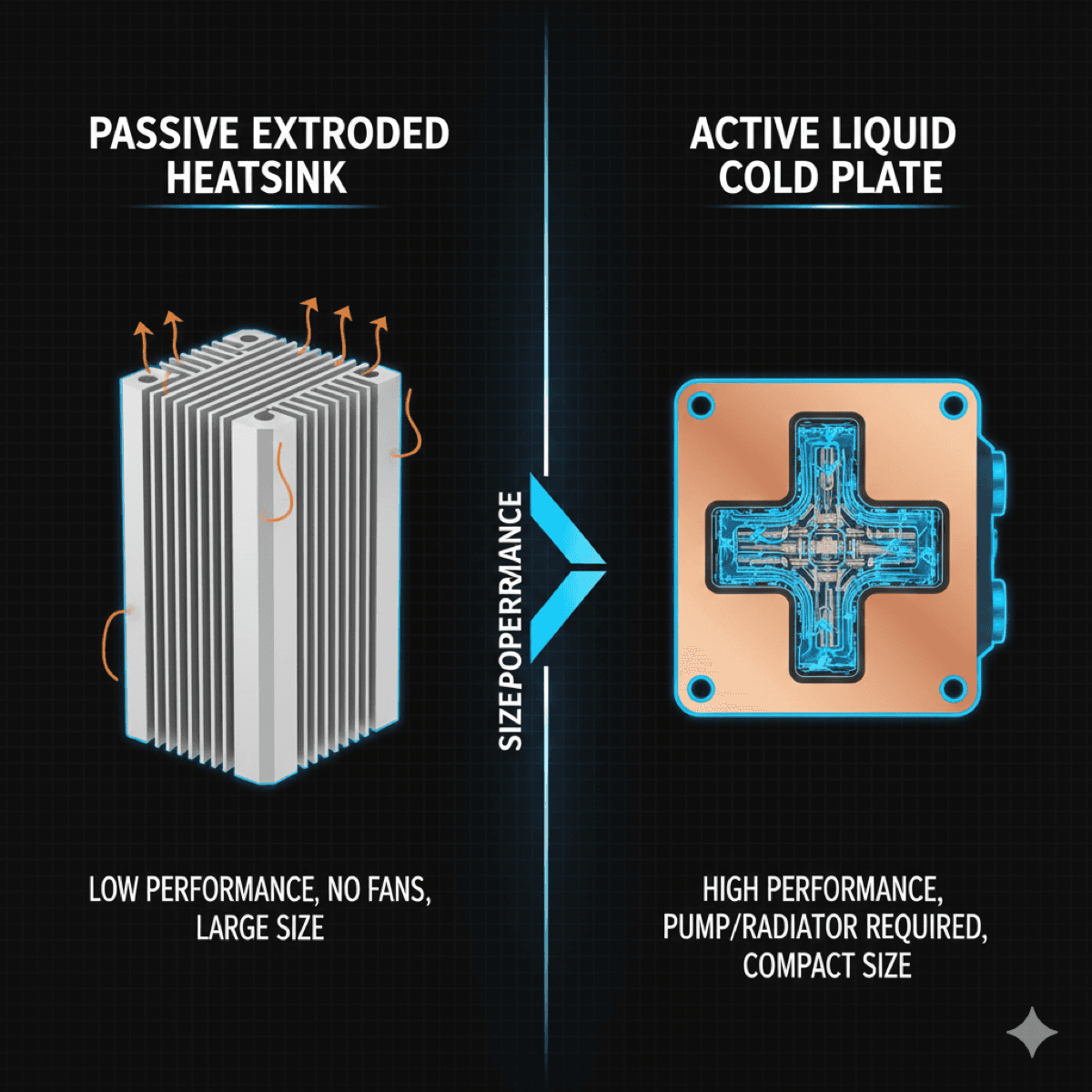
Heat sinks are the default choice unless specific requirements demand liquid cooling.
Ideal Applications for Heat Sinks:
Low to moderate power (<500W):
- Single or few power devices
- Adequate space for heatsink
- Reasonable ambient temperature
Simple systems:
- Standalone equipment
- Minimal maintenance expected
- Cost-sensitive applications
Distributed heat sources:
- Multiple low-power devices
- Individual heatsinks easier than plumbing
- Modular replacement beneficial
Outdoor/harsh environments:
- No leak concerns
- No coolant freeze risk
- Sealed enclosure compatible (with design)
Heat Sink Selection Guide:
Power < 50W: → Natural convection heatsink → No moving parts → Highest reliability
Power 50-200W: → Small forced-air heatsink → Compact fan → Monitor fan health
Power 200-500W: → Large forced-air heatsink → Consider redundant fans → Filtration if dusty environment
Power > 500W: → Consider transition to liquid → Air becomes impractical → Multiple large fans, noise, size
Heat Sink Advantages:
✓ Simple—no system integration ✓ No leak risk ✓ Low maintenance ✓ Lower initial cost ✓ Easy field replacement ✓ No freeze protection needed ✓ Widely available ✓ Proven reliability
When to Use Cold Plates
Cold plates become necessary or advantageous in specific circumstances.
Compelling Cases for Cold Plates:
High power density:
- Heat flux > 30 W/cm²
- Compact form factor required
- Multiple high-power devices close together
Example: 1kW power module in 50cm² footprint = 20 W/cm² → Challenging for air cooling → Straightforward for liquid
High ambient temperature:
- Ta > 45-50°C
- Reduced ΔT for air cooling
- Liquid maintains capacity
Example: Desert solar inverter at 55°C ambient → Air cooling severely derated → Liquid cooling sized for heat load
Sealed enclosure requirement:
- IP65+ protection
- No filtered ventilation allowed
- Heat must be moved outside
Example: Outdoor BESS in dusty environment → Sealed enclosure necessary → Cold plate to external radiator
Noise constraints:
- <40 dBA requirement
- High-velocity fans unacceptable
- Liquid can be nearly silent
Example: Medical imaging equipment → Silent operation required → Cold plate + remote radiator
Cold Plate Advantages:
✓ 10-100× higher heat flux capability ✓ Compact cooling solution ✓ Maintains performance at high ambient ✓ Enables sealed enclosures ✓ Lower noise (pump + remote radiator) ✓ Consistent temperature across devices ✓ Scalable to very high power
Cost-Benefit Analysis
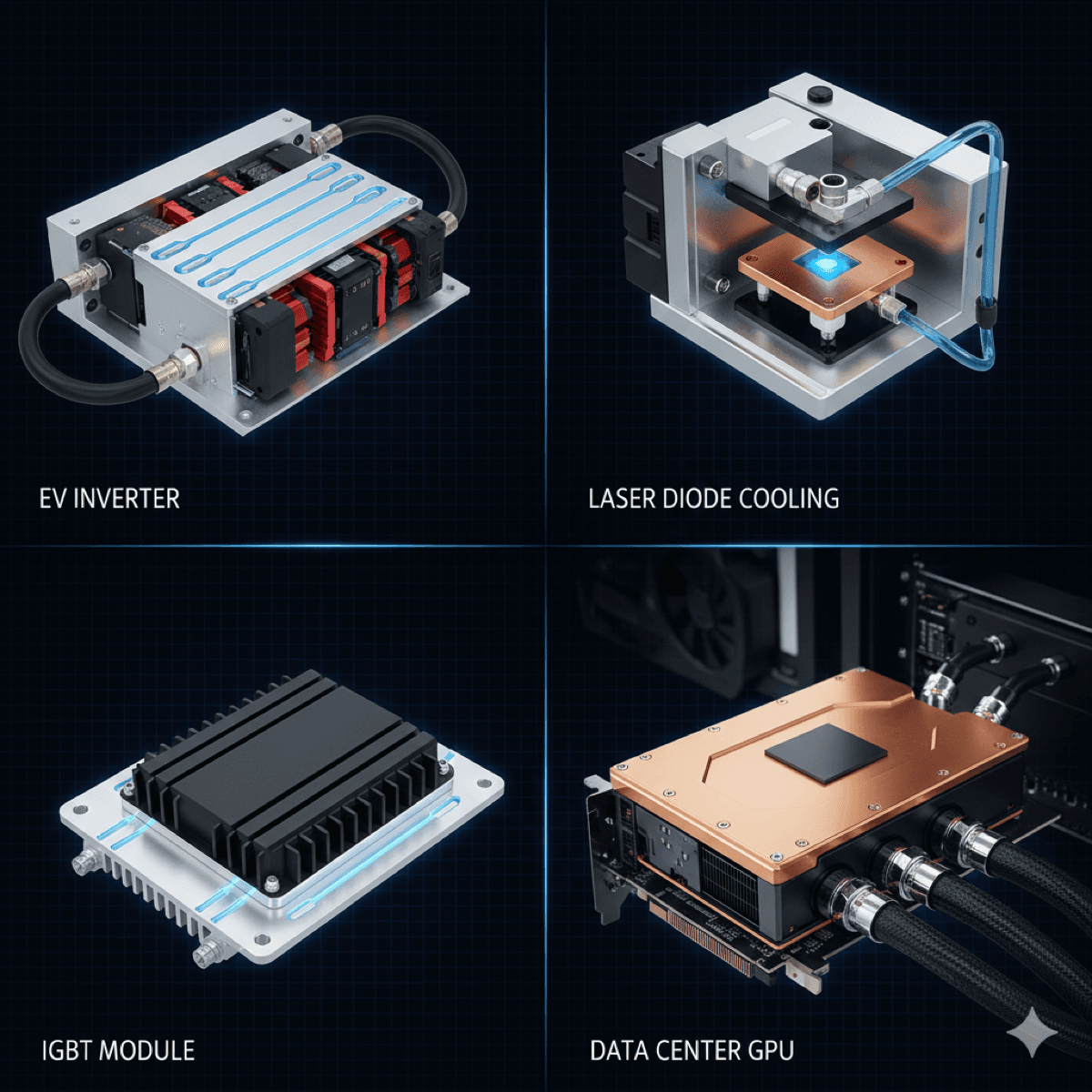
Total cost of ownership determines economic viability of each approach.
Initial Cost Comparison:
100W cooling requirement:
Air cooling:
- Heatsink: $30-50
- Fan: $10-20
- TIM: $5
- Total: $45-75
Liquid cooling:
- Cold plate: $100-200
- Pump: $50-150
- Reservoir: $20-50
- Heat exchanger: $50-150
- Plumbing: $30-50
- Coolant: $20-50
- Total: $270-650
Liquid is 4-8× higher initial cost.
1kW cooling requirement:
Air cooling:
- Large heatsink: $100-200
- Multiple fans: $50-100
- TIM: $10
- Total: $160-310
Liquid cooling:
- Cold plate: $150-300
- System (pump, HX, etc.): $200-400
- Total: $350-700
Liquid is 2-3× higher initial cost at higher power.
Operating Cost:
Power consumption (1kW thermal):
- Fans (high flow): 30-50W
- Pump (typical): 10-20W
- Radiator fans: 10-20W
Similar operating power, slight edge to liquid.
Maintenance Cost:
Air cooling:
- Fan replacement (2-5 years): $20-50
- Filter cleaning/replacement: $10-20/year
- Total 10-year: $50-300
Liquid cooling:
- Pump replacement (5-10 years): $50-150
- Coolant change (3-5 years): $30-50
- Inspection: Minimal
- Total 10-year: $80-200
Similar long-term maintenance costs.
Break-Even Analysis:
Cold plates become cost-competitive when:
- Air cooling requires oversized enclosure
- Multiple fans + heatsinks approach cold plate cost
- Reliability requirements favor cold plates
- Noise constraints add premium to fans
- Fan failures are costly (downtime)
Reliability Comparison
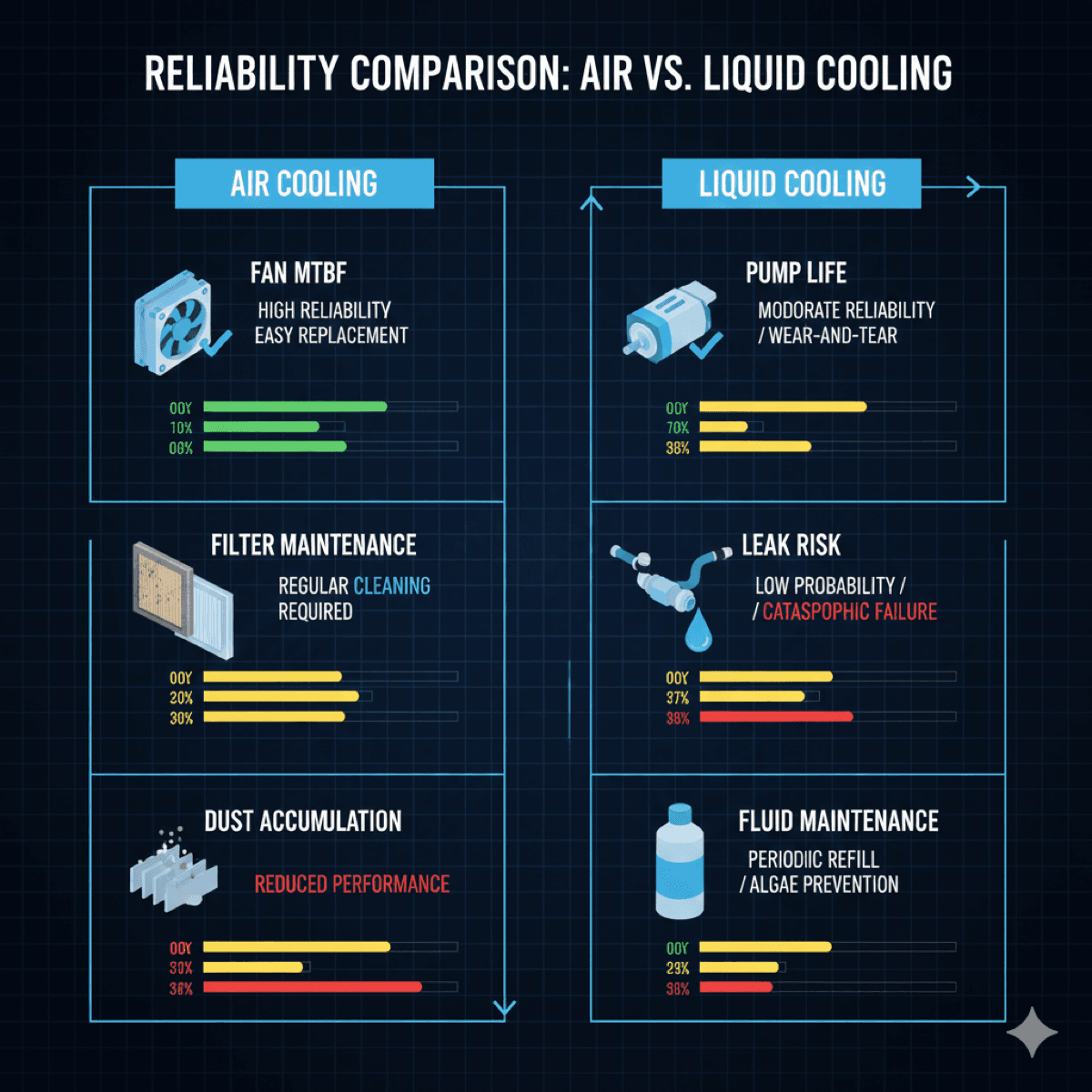
Reliability considerations often drive the cooling technology decision.
Heat Sink Reliability:
No moving parts (natural convection):
- Essentially infinite life
- Only TIM degradation concern
- Highest reliability option
With fans:
- Fan MTBF: 30,000-100,000 hours
- Typical failure mode: Bearing wear
- Fan is single point of failure (usually)
Failure modes:
- Fan failure → rapid overheating
- Filter clogging → gradual degradation
- TIM degradation → gradual Rth increase
Cold Plate Reliability:
Pump:
- MTBF: 50,000-200,000 hours
- Sealed pumps very reliable
- Critical single point of failure
Cold plate:
- No moving parts
- Very reliable
- Corrosion possible with poor coolant
System:
- More components = more failure modes
- But each component can be robust
- Leak potential is key concern
Failure modes:
- Pump failure → rapid overheating
- Leak → immediate system issue
- Coolant degradation → gradual loss of protection
Reliability Enhancement:
For heat sinks:
- Redundant fans
- Fan monitoring with alarm
- Oversized for fan-failure case
For cold plates:
- Redundant pumps
- Coolant monitoring
- Leak detection systems
- Quality fittings and connections
Application-Specific Reliability:
Telecom (99.999% uptime):
- Historically favor natural convection
- If forced air: redundant fans
- Liquid requires redundant pumps
Automotive (harsh environment):
- Vibration concern for fans
- Liquid systems proven in vehicles
- Careful coolant selection
Industrial (maintenance available):
- Fan replacement acceptable
- Liquid if performance needed
- Regular maintenance assumed
Decision Framework
A systematic approach ensures optimal technology selection.
Step 1: Determine Power Density
Calculate: P_total / Footprint area
< 10 W/cm²: Heat sink strongly preferred 10-30 W/cm²: Either viable, consider other factors
30 W/cm²: Cold plate likely required
Step 2: Check Constraints
Ambient temperature:
- < 40°C: Both viable
- 40-50°C: Cold plate advantage
-
50°C: Cold plate likely required
Noise limit:
- No limit: Heat sink easier
- < 50 dBA: Either viable
- < 40 dBA: Cold plate advantage
Enclosure:
- Ventilated: Heat sink simpler
- Sealed: Cold plate moves heat outside
Step 3: Evaluate System Factors
Space:
- Adequate: Heat sink
- Constrained: Cold plate
Weight:
- Critical: Heat sink (usually lighter)
- Flexible: Either
Reliability:
- Maximum: Natural convection or cold plate
- Standard: Either
Maintenance:
- Minimal: Heat sink (fewer parts)
- Regular: Either
Step 4: Cost Analysis
Calculate total cost over product life:
- Initial cost
- Operating cost
- Maintenance cost
- Downtime cost (if applicable)
Decision Tree:
Power < 200W AND space available → Heat sink Power > 1kW OR power density > 30 W/cm² → Cold plate Sealed enclosure required → Cold plate Noise < 40 dBA required → Cold plate Maximum reliability required → Natural convection OR quality liquid Cost primary concern → Heat sink (usually)
When Technology is Borderline:
If either technology can meet requirements:
- Default to heat sink (simpler)
- Unless cold plate offers clear advantage
- Consider future power growth
- Factor in maintenance capability
Free Resources: Download our Cold Plate Selection Guide for help choosing the right cold plate, and our Thermal Design Checklist for a complete thermal design review.