Air Cooling vs Liquid Cooling for Power Electronics: Complete Comparison
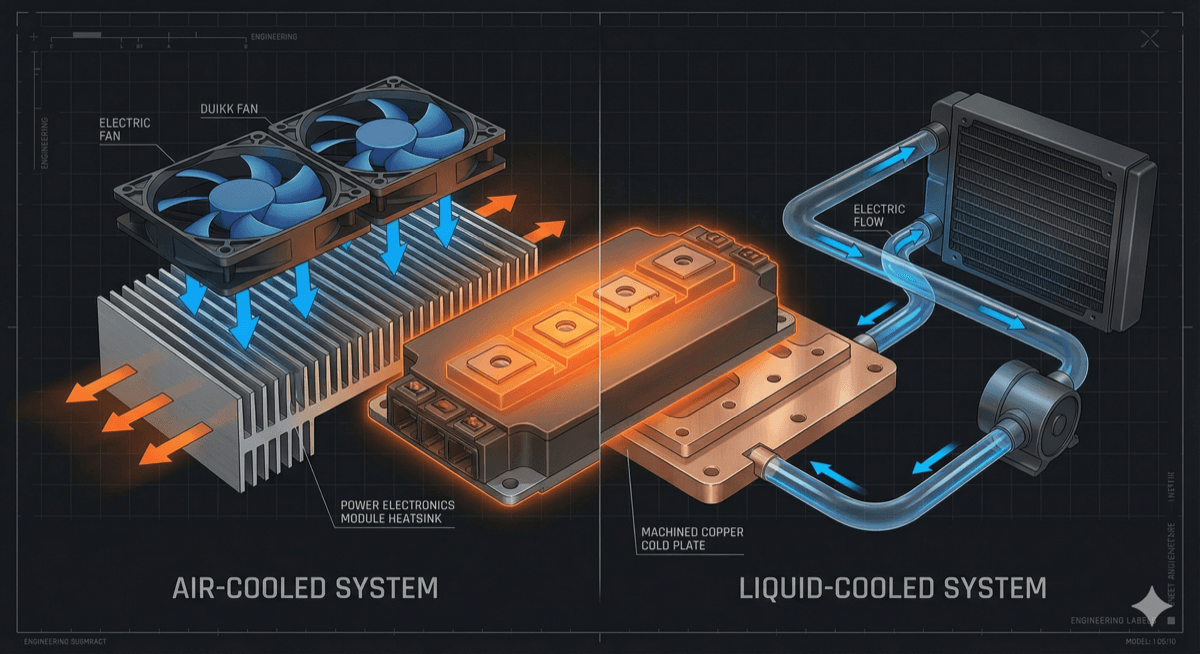
Choosing between air cooling and liquid cooling is one of the most impactful decisions in power electronics thermal design. The right choice depends on power density, reliability requirements, cost constraints, and operating environment. This comprehensive comparison helps you understand the trade-offs and make the optimal decision for your application.
When to Use Air Cooling
Air cooling remains the dominant thermal management approach for most power electronics applications due to its simplicity and reliability.
Ideal Applications:
- Power dissipation under 500W (natural convection) or 2-5kW (forced air)
- Indoor installation with controlled ambient
- Cost-sensitive applications
- Products requiring minimal maintenance
- Consumer and light commercial equipment
Air Cooling Advantages:
- Simplicity: No pumps, reservoirs, or fluid loops to fail
- Lower Cost: Heat sinks are inexpensive; fans are commodity items
- No Leak Risk: Eliminates fluid contamination concerns
- Easier Serviceability: No fluid handling during maintenance
- Lighter Weight: Important for portable or transportation applications
Air Cooling Limitations:
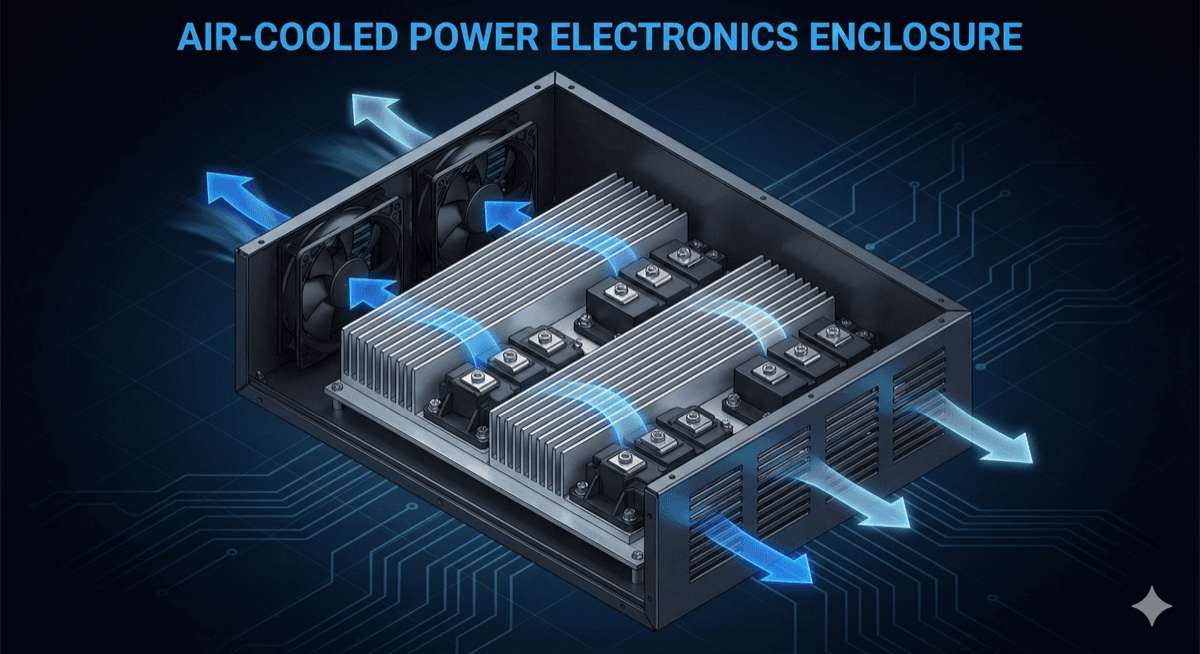
- Heat Transfer Coefficient: Air's low thermal conductivity (0.026 W/mK) limits heat transfer rates. Typical h = 10-150 W/m²K.
- Size Requirements: Large heat sink surface area needed for high power
- Noise: High-CFM fans create acoustic problems
- Ambient Sensitivity: Performance degrades significantly at high ambient temperatures
- Dust/Contamination: Fins clog over time, requiring maintenance or filtering
When to Use Liquid Cooling
Liquid cooling becomes attractive—and eventually necessary—as power density increases.
Ideal Applications:
- Power dissipation above 3-5kW per unit
- High power density requirements (>50 W/cm²)
- Harsh ambient environments (high temperature, dusty, corrosive)
- Noise-sensitive applications
- High-reliability, long-lifetime products
- Datacenter and telecom equipment
- EV fast chargers >150kW
Liquid Cooling Advantages:
- Heat Transfer: Water's thermal capacity is 3500x greater than air. Heat transfer coefficients of 1000-10000 W/m²K are achievable.
- Compact Design: Cold plates can be 10-50x smaller than equivalent air-cooled heat sinks
- Remote Heat Rejection: Separate heat exchanger location from electronics
- Consistent Performance: Less sensitive to ambient temperature
- Quiet Operation: No fans near sensitive electronics
- Sealed Enclosure Compatible: Electronics can be completely sealed from environment
Liquid Cooling Challenges:
- Complexity: Pumps, reservoirs, heat exchangers, fluid lines add components
- Leak Risk: Fluid leaks can cause electrical failures
- Maintenance: Fluid needs monitoring and eventual replacement
- Cost: System cost typically 2-5x air cooling
- Pump Reliability: Pumps can be the weakest link
- Freeze Protection: Required for outdoor applications
Cost Comparison Analysis
Understanding the true cost comparison requires looking beyond component prices.
Air Cooling Costs:
Initial:
- Heat sinks: $5-50 per device
- Fans: $5-30 each
- Filters: $2-10
Ongoing:
- Fan replacement: Every 3-7 years
- Filter maintenance: Quarterly to annually
- Energy: Fan power consumption
Liquid Cooling Costs:
Initial:
- Cold plates: $50-500 per device
- Pump: $50-500
- Reservoir: $20-100
- Heat exchanger: $100-1000
- Fittings/lines: $50-200
- Coolant: $20-100
- System integration: $100-500
Ongoing:
- Pump replacement: Every 5-10 years
- Coolant replacement: Every 2-5 years
- Leak detection/monitoring
Break-Even Analysis:
At low power (<1kW): Air cooling wins on cost by 3-5x At medium power (1-5kW): Costs are comparable when considering system size At high power (>5kW): Liquid cooling often wins due to smaller enclosure size
Hidden Cost Factors:
- Larger air-cooled enclosures cost more to manufacture and ship
- Acoustic treatments for loud fans add cost
- Field failures from overheating have warranty costs
- Liquid cooling enables smaller, lighter products (important for some markets)
Reliability Comparison
Both approaches have reliability considerations that must be addressed in design.
Air Cooling Reliability:
Failure Modes:
- Fan bearing wear → reduced airflow → overheating
- Dust accumulation → blocked airflow → overheating
- Thermal cycling fatigue in heat sink mounting
- TIM degradation over time
Mitigation Strategies:
- Use high-quality fans with ball bearings (50,000+ hour life)
- Include airflow sensing with thermal shutdown
- Design for N+1 fan redundancy
- Specify long-life TIM materials
- Include accessible filters
Liquid Cooling Reliability:
Failure Modes:
- Pump failure → no flow → rapid overheating
- Leaks → electrical damage, corrosion
- Coolant degradation → reduced heat transfer
- Corrosion in flow path
- Air bubble formation → flow restriction
Mitigation Strategies:
- Use industrial-grade pumps (not PC water cooling parts)
- Include flow sensing with thermal shutdown
- Specify compatible materials throughout (no mixed metals)
- Use corrosion inhibitors in coolant
- Design for bubble tolerance
- Include leak detection
- Consider redundant pumps for critical applications
MTBF Comparison: Well-designed systems of either type can achieve 100,000+ hour MTBF. The key is proper component selection and fault tolerance design.
Hybrid Approaches
The best solution isn't always purely air or purely liquid—hybrid approaches offer compelling advantages.
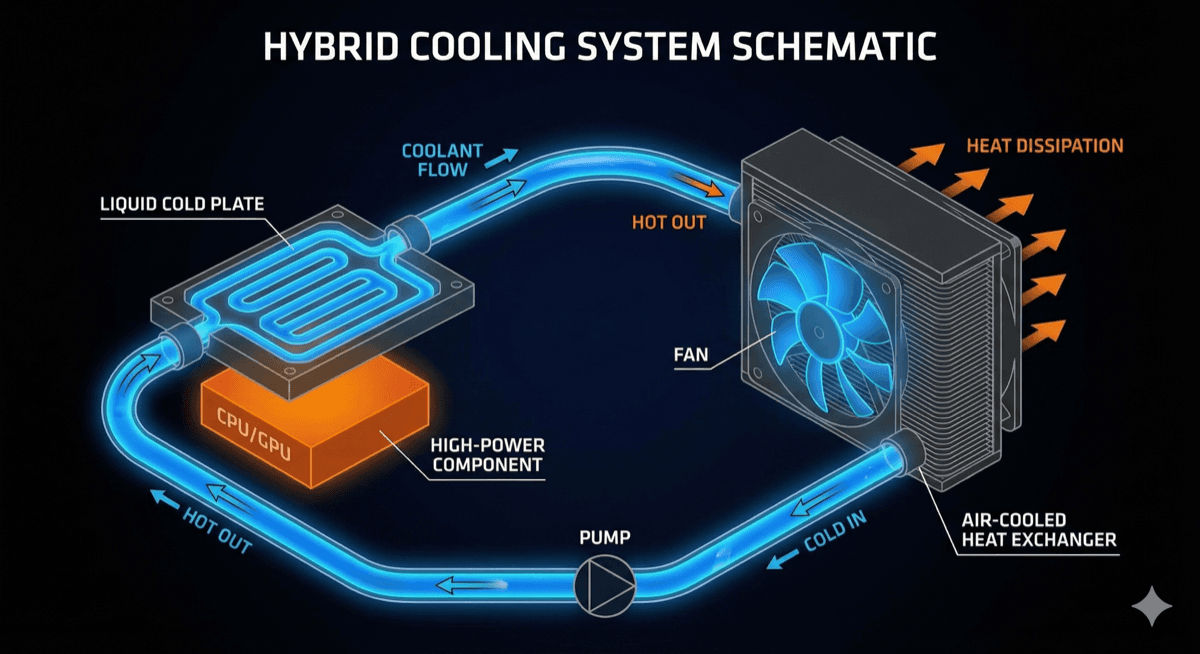
Liquid-to-Air Heat Exchanger: Use liquid cooling at the heat source, reject heat via remote radiator with fans. Benefits:
- Decouples electronics from airflow
- Electronics can be sealed
- Fans can be replaced without accessing electronics
- Heat rejection location is flexible
Two-Phase Cooling: Use phase change (evaporation/condensation) for high heat flux areas:
- Heat pipes for moderate loads
- Vapor chambers for high-flux spreading
- Pumped two-phase for highest performance
Air Cooling with Liquid Assist: Primarily air-cooled, with liquid circuit for highest-power components:
- Simpler than full liquid system
- Targets liquid cooling where it's most effective
- Maintains air cooling simplicity for moderate components
Application Examples:
EV Charger (150kW):
- Power modules: Cold plate liquid cooled
- Inductors/capacitors: Air cooled
- Result: Optimal balance of performance and complexity
Server Power Supply:
- Primary: Forced air through finned heat sinks
- Hot spot: Heat pipe from MOSFETs to heat sink
- Result: Improved reliability without liquid system
Telecom Rectifier:
- Sealed enclosure with internal cold plates
- External liquid-to-air heat exchanger
- Result: Protected electronics, field-serviceable cooling
Decision Framework
Use this framework to guide your cooling technology selection:
Step 1: Calculate Power Density Power density = Total dissipation / Available enclosure volume
- <10 W/L: Air cooling is straightforward
- 10-50 W/L: Air cooling possible with careful design
- 50-200 W/L: Liquid cooling likely needed
-
200 W/L: Advanced liquid cooling required
Step 2: Assess Operating Environment
- Indoor, climate controlled: Air cooling viable
- Outdoor, wide temperature range: Liquid more robust
- Dusty/corrosive: Sealed enclosure with liquid preferred
- Altitude >2000m: Derate air cooling significantly
Step 3: Consider Product Requirements
- Noise limits: Liquid cooling is quieter
- Maintenance access: Air is simpler to service
- Lifetime: Both can achieve 10+ years with proper design
- Cost sensitivity: Air cooling is cheaper at low power
Step 4: Evaluate Supply Chain
- Air cooling: More suppliers, commodity components
- Liquid cooling: Specialized suppliers, custom cold plates
- Lead times: Air typically faster
- Second sources: Easier for air cooling
Step 5: Plan for Future
- Power growth: Liquid cooling has more headroom
- Platform reuse: Liquid loop can accommodate upgrades
- Technology trends: Power density is increasing
Quick Decision Guide:
- <1kW, cost-sensitive: Air cooling
- 1-5kW, performance-focused: Evaluate both
-
5kW, high density: Liquid cooling
- Harsh environment any power: Consider liquid
- Noise-critical any power: Consider liquid