Aluminum vs Copper Heat Sinks: When Copper Is Worth the Cost
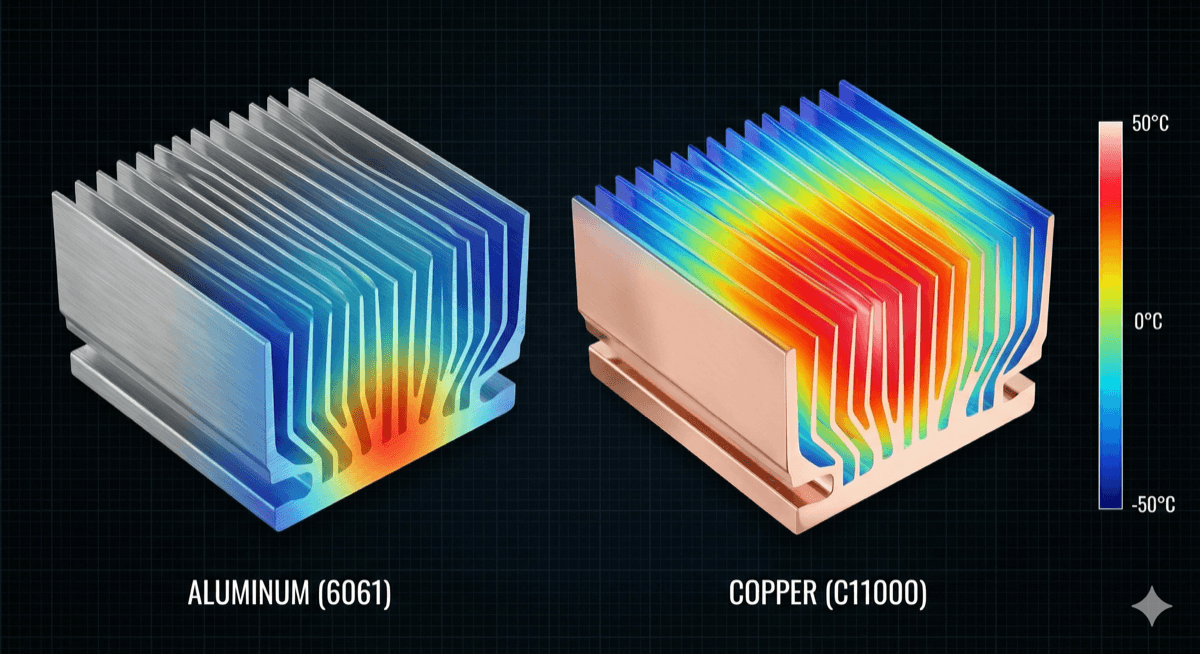
Aluminum and copper are the two primary materials for heatsink construction, each offering distinct advantages. This comprehensive comparison examines thermal performance, weight, cost, manufacturing considerations, and application-specific trade-offs to help you select the optimal material for your thermal management needs.
Material Properties Comparison
Understanding the fundamental material differences is essential for informed selection.
Thermal Properties:
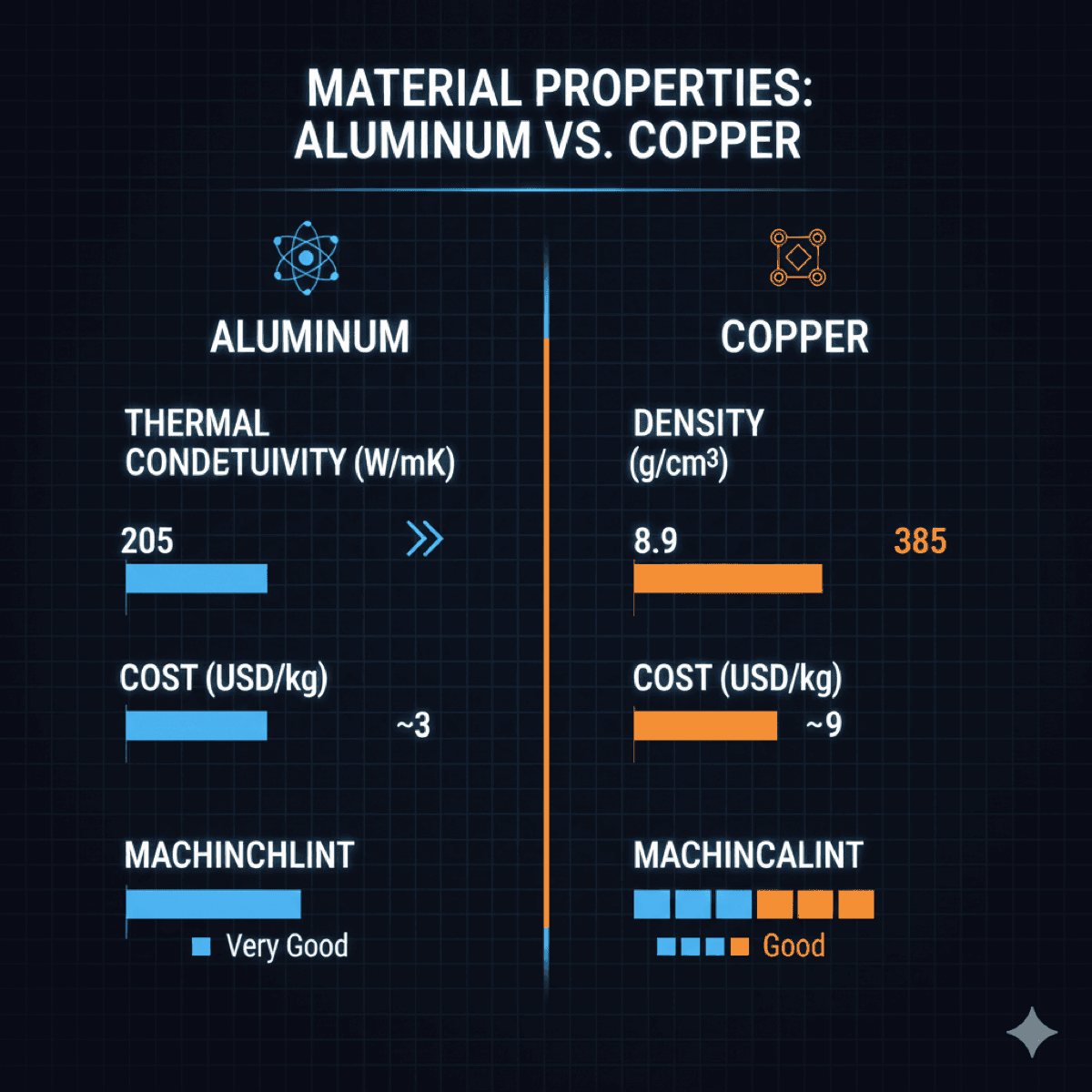
| Property | Aluminum (6063-T5) | Copper (C110) | Ratio | |----------|-------------------|---------------|-------| | Thermal Conductivity | 200 W/mK | 390 W/mK | 1:2 | | Specific Heat | 900 J/kgK | 385 J/kgK | 2.3:1 | | Thermal Diffusivity | 8.4×10⁻⁵ m²/s | 1.1×10⁻⁴ m²/s | 1:1.3 |
Copper conducts heat nearly 2× faster than aluminum.
Physical Properties:
| Property | Aluminum | Copper | Ratio | |----------|----------|--------|-------| | Density | 2.7 g/cm³ | 8.9 g/cm³ | 1:3.3 | | Elastic Modulus | 69 GPa | 117 GPa | 1:1.7 | | Melting Point | 660°C | 1085°C | 1:1.6 |
Copper is 3.3× heavier than aluminum.
Economic Comparison:
Raw material cost (approximate):
- Aluminum: $2-4/kg
- Copper: $8-12/kg
Considering weight difference:
- For same heatsink volume: Copper is 10-15× more expensive
- For same thermal performance: Copper is 3-5× more expensive
Corrosion Resistance:
Aluminum:
- Forms protective oxide layer
- Good atmospheric corrosion resistance
- Can be anodized for enhanced protection
Copper:
- Develops patina (tarnish) over time
- Generally corrosion resistant
- Can require plating for appearance/solderability
Thermal Performance Analysis
The 2× conductivity advantage of copper doesn't always translate to 2× thermal performance.
When Copper Matters Most:
High heat flux with small source:
- Heat must spread before convecting
- Spreading resistance dominates
- Copper's higher k reduces spreading resistance
Calculation example: For 10mm² source on 100mm² heatsink base:
- Aluminum spreading resistance: 0.35°C/W
- Copper spreading resistance: 0.18°C/W
- Copper advantage: 50% reduction in spreading
Short conduction paths:
- Thin bases (<5mm)
- Limited space for heat spreading
- High power density applications
When Aluminum is Nearly Equal:
Large heat source covering most of base:
- Minimal spreading needed
- Convective resistance dominates
- Material conductivity less important
Tall fins:
- Fin efficiency decreases with height
- Tip runs cooler than base
- Higher k provides diminishing benefit
Low power density:
- Temperature gradients small
- Convective resistance dominates
- Material makes little difference
Quantifying the Difference:
For typical forced-air heatsinks:
- Small heat source (<20% of base): Copper 15-30% better
- Medium source (20-50% of base): Copper 5-15% better
- Large source (>50% of base): Copper <5% better
The performance improvement rarely justifies 3-5× cost increase.
Fin Efficiency:
Fin efficiency = tanh(mL) / (mL) Where m = √(hP/kA)
Higher k (copper) → lower m → higher fin efficiency But effect is modest for typical fin geometries.
Aluminum fin efficiency: 70-90% Copper fin efficiency: 85-95% Practical improvement: 5-15%
Manufacturing Considerations
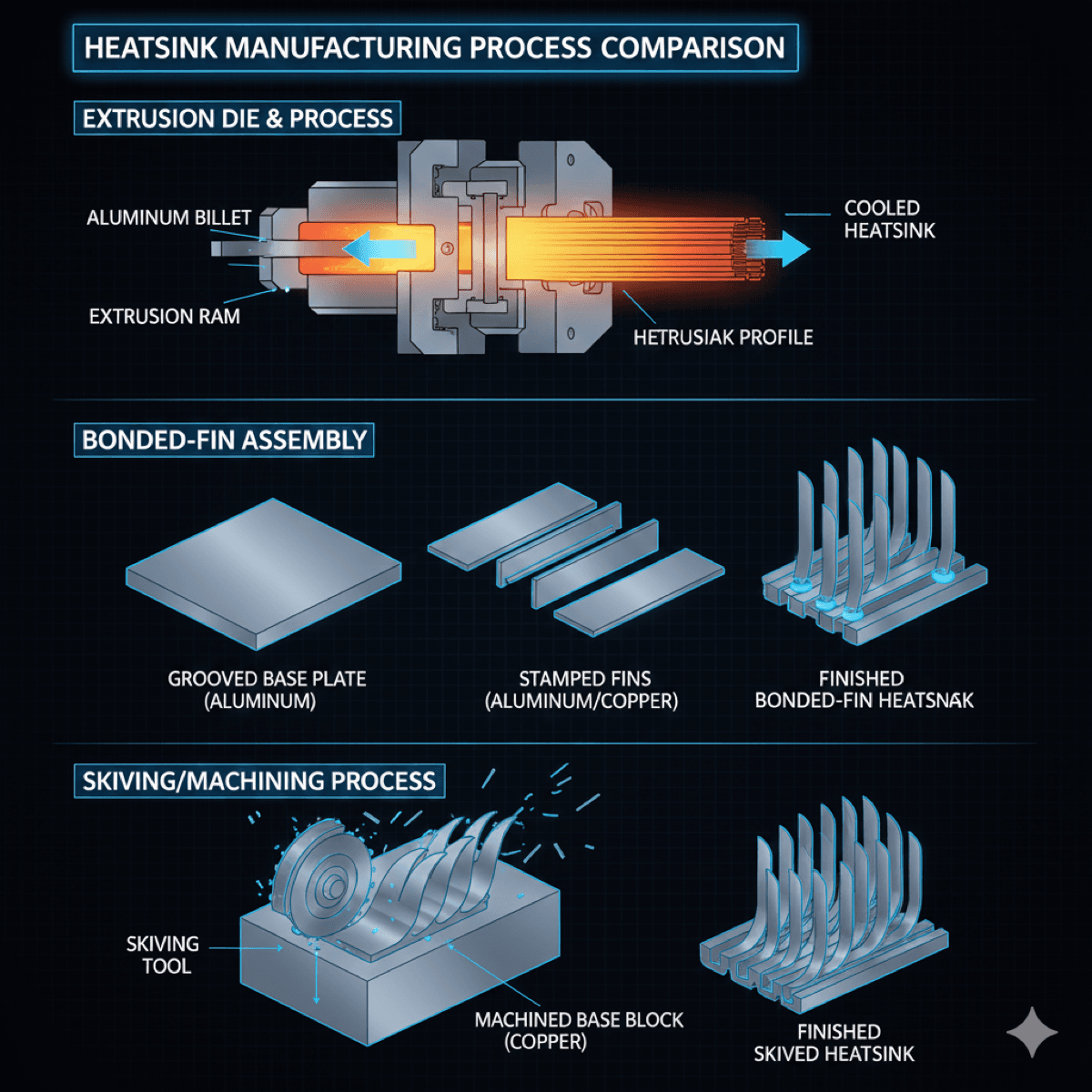
Manufacturing method significantly affects material choice and heatsink performance.
Extrusion:
Aluminum:
- Most common method for heatsinks
- Complex profiles possible
- Cost-effective for high volume
- Fin aspect ratio up to 10:1
Copper:
- Can be extruded but less common
- Requires higher forces
- More limited profiles
- Generally more expensive
Verdict: Aluminum dominates extrusion
Die Casting:
Aluminum:
- Good for complex 3D shapes
- Lower conductivity than wrought (~140 W/mK)
- Most economical for complex geometries
Copper:
- Rarely die cast for heatsinks
- High melting point challenges tooling
Verdict: Aluminum preferred
Machining:
Aluminum:
- Easy to machine
- Lower tool wear
- High precision possible
Copper:
- Gummier, harder to machine
- Higher tool wear
- Good for prototypes
Verdict: Both viable, aluminum preferred for production
Skiving:
Creating thin fins by slicing the base material:
- Aluminum: Requires careful process control
- Copper: Better suited (more ductile)
Skived copper heatsinks offer:
- Very thin fins (0.3-0.5mm)
- High fin density
- Excellent thermal performance
Verdict: Copper can be superior
Bonded Fins:
Fins attached to base by epoxy, solder, or brazing:
- Aluminum fins + aluminum base: Common
- Copper fins + copper base: High performance
- Copper fins + aluminum base: Hybrid approach
Interface adds thermal resistance, reducing material advantage.
Verdict: Hybrid approaches attractive
Weight and Mounting Considerations
The 3.3× weight difference has significant system implications.
Weight Impact:
For equivalent thermal performance:
- Copper heatsinks are typically 2-2.5× heavier
- Even with smaller copper heatsinks (from better spreading)
Example: 100W application heatsink:
- Aluminum solution: 400g
- Copper solution: 900g
Mounting Stress:
Heavier heatsinks create:
- Higher stress on component leads (TO-220, etc.)
- Greater vibration/shock loads
- More demanding mechanical design
PCB-mounted considerations:
- Copper heatsink may require mechanical support
- Aluminum can often be self-supporting
- Thermal cycling creates more stress with heavy heatsinks
Mobile/Portable Applications:
Weight is premium in:
- Aerospace
- Automotive
- Portable electronics
- Robotics
Aluminum almost always preferred unless thermal performance mandates copper.
Stationary Equipment:
Weight less critical in:
- Industrial equipment
- Server/datacenter
- Power supplies
- Telecom
Copper can be considered if thermal benefit justifies cost.
Vibration and Shock:
G-forces multiply weight impact:
- 50G shock × 1kg heatsink = 50kg force
- Must be supported by mounting
Mitigation:
- Dedicated mounting brackets
- Multiple fastening points
- Isolation mounts for sensitive components
Aluminum's lighter weight simplifies vibration/shock design.
Application Guidelines
Matching material to application requirements optimizes cost and performance.
Use Aluminum When:
Cost is important (almost always):
- Production volume
- Consumer products
- Standard industrial equipment
Weight matters:
- Portable devices
- Aerospace
- Automotive
Heat source covers >30% of base:
- Spreading resistance not dominant
- Copper benefit minimal
Standard manufacturing:
- Extruded profiles
- Die casting
- Commodity heatsinks
Use Copper When:
Small, concentrated heat source:
- Chips <10mm²
- Power modules with small die
- LEDs
Maximum performance required:
- Aerospace/military
- Extreme environment
- Premium applications
Space extremely constrained:
- Copper's better spreading critical
- Can't increase heatsink size
- Size reduction worth cost premium
Hybrid design:
- Copper insert for spreading
- Aluminum body for fins/structure
- Common in high-performance applications
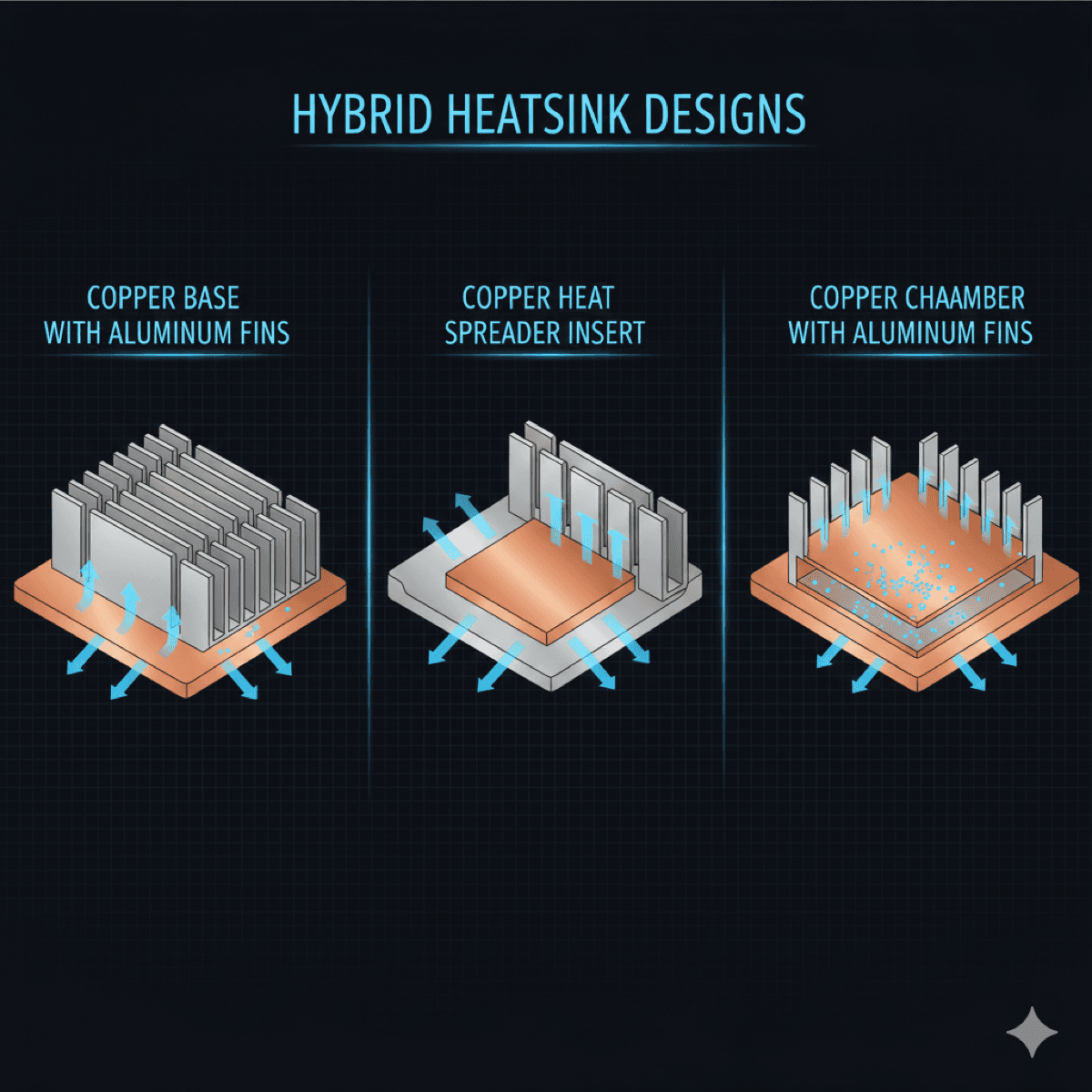
Hybrid Approaches:
Copper base + aluminum fins:
- Best of both worlds
- Copper spreads heat
- Aluminum fin structure (lighter, cheaper)
- Bonded or brazed assembly
Copper insert (heat pipe spreading):
- Small copper spreader under heat source
- Heat pipes to aluminum fins
- Lightweight with good performance
Vapor chamber + aluminum heatsink:
- Copper vapor chamber base
- Aluminum fin structure
- Premium performance, moderate weight
Decision Framework
A systematic approach to material selection ensures optimal choices.
Step 1: Analyze Heat Source
Calculate source area / heatsink base area ratio:
- <0.2: Copper provides significant benefit
- 0.2-0.5: Moderate copper benefit
-
0.5: Minimal copper benefit
Determine heat flux:
-
25 W/cm²: Consider copper for spreading
- <10 W/cm²: Aluminum adequate
Step 2: Evaluate Constraints
Weight limit? → Aluminum preferred
Cost target? → Aluminum typically 3-5× cheaper
Space constraint? → Copper enables smaller size
Manufacturing preference? → Aluminum for extrusion/casting
Step 3: Calculate Thermal Budget
Determine allowable thermal resistance: Rth = (Tj_max - Ta) / P
Compare to available heatsink options:
- Aluminum heatsink Rth
- Copper heatsink Rth
If both meet requirements → choose aluminum If only copper meets → accept cost premium If neither meets → consider liquid cooling
Step 4: Consider Total Cost
Raw material cost + manufacturing + assembly + logistics
For volume production, aluminum typically wins unless:
- Copper reduces heatsink count
- Copper eliminates fan
- Copper enables smaller enclosure
Decision Matrix:
| Factor | Points for Al | Points for Cu | |--------|---------------|---------------| | Cost sensitive | +2 | 0 | | Weight limited | +2 | 0 | | Small heat source | 0 | +2 | | High heat flux | 0 | +1 | | Space constrained | 0 | +1 | | High volume production | +1 | 0 | | Premium application | 0 | +1 |
Sum points and select material with higher score.