IP Ratings Explained: Designing Outdoor Power Electronics Enclosures
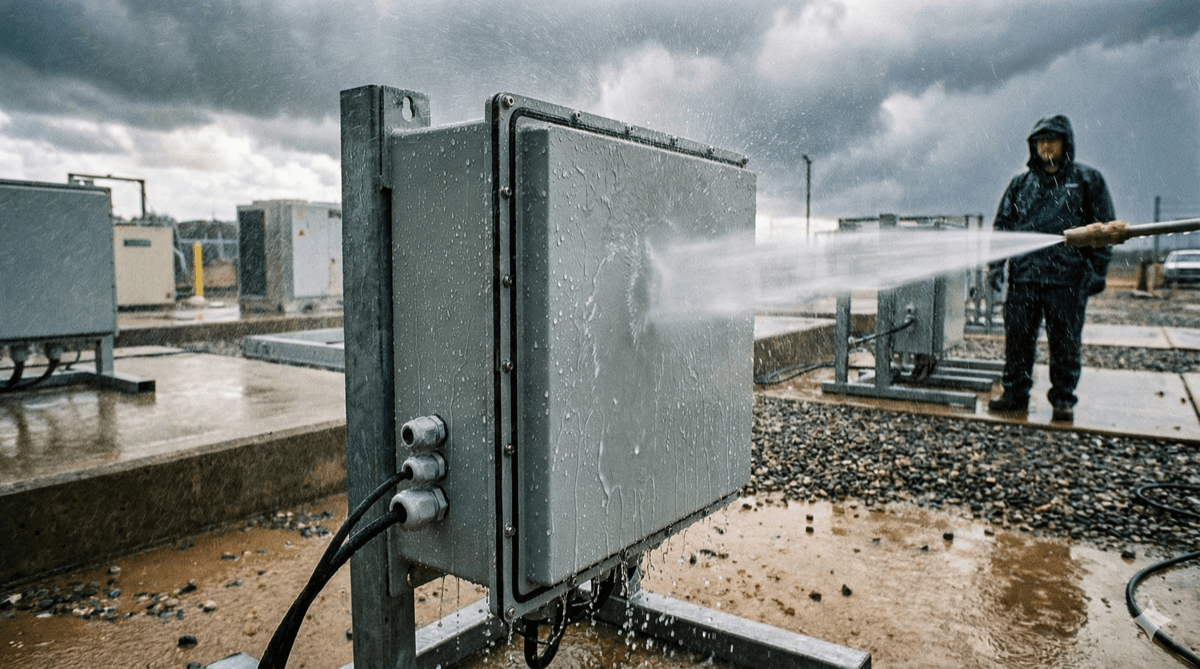
IP (Ingress Protection) ratings define how well enclosures protect internal components from solid particles and liquids. For outdoor power electronics—EV chargers, solar inverters, battery storage systems—achieving the right IP rating is essential for reliability and safety. This guide explains IP ratings, their testing requirements, and practical design strategies for meeting protection targets.
Understanding IP Ratings
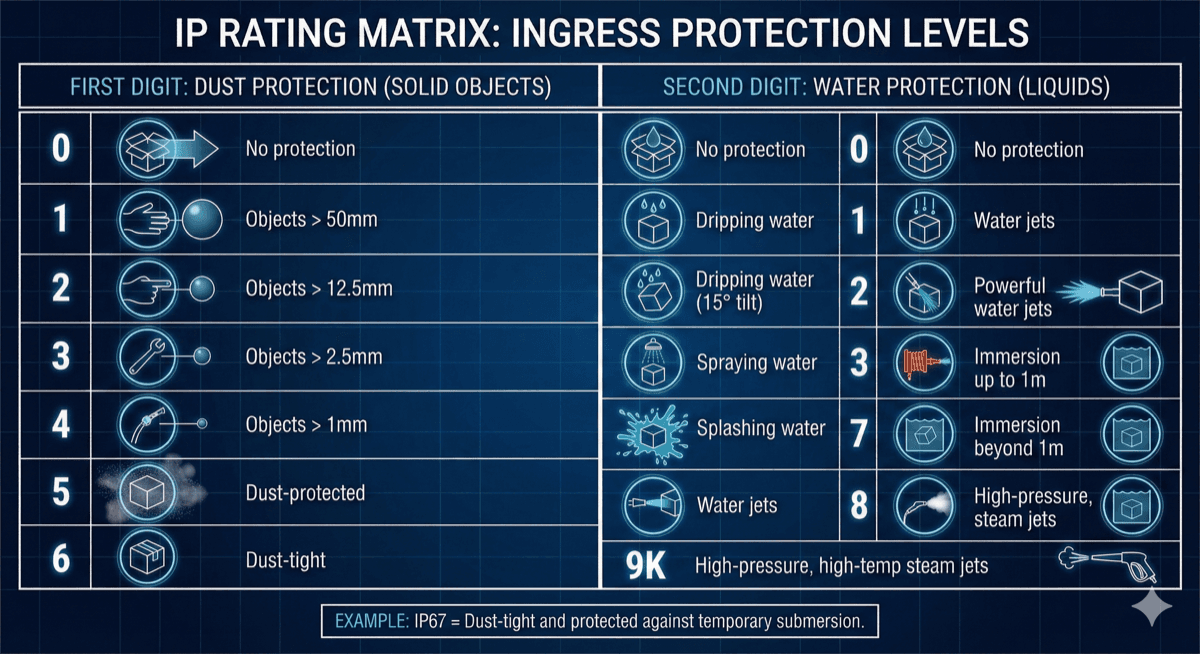
IP ratings follow the standard IEC 60529 and consist of two digits: the first indicates solid particle protection (0-6), the second indicates liquid protection (0-9).
First Digit - Solid Particle Protection: 0 - No protection 1 - Protected against objects >50mm (back of hand) 2 - Protected against objects >12.5mm (finger) 3 - Protected against objects >2.5mm (tools, wires) 4 - Protected against objects >1mm (small wires) 5 - Dust protected (limited ingress permitted) 6 - Dust tight (no ingress)
Second Digit - Liquid Protection: 0 - No protection 1 - Dripping water (vertical) 2 - Dripping water at 15° tilt 3 - Spraying water at 60° from vertical 4 - Splashing water from any direction 5 - Water jets (6.3mm nozzle, 12.5 L/min) 6 - Powerful water jets (12.5mm nozzle, 100 L/min) 7 - Temporary immersion (1m depth, 30 min) 8 - Continuous immersion (depth specified by manufacturer) 9 - High-pressure, high-temperature water jets
Common ratings for outdoor power electronics:
- IP54: Dust protected, splash resistant. Minimum for most outdoor applications.
- IP55: Dust protected, water jet resistant. Common for exposed installations.
- IP65: Dust tight, water jet resistant. Standard for outdoor equipment.
- IP66: Dust tight, powerful water jet resistant. For exposed/high-pressure wash areas.
- IP67: Dust tight, temporary immersion resistant. For potential flooding scenarios.
Sealing Strategies
Achieving high IP ratings requires systematic attention to all potential ingress paths:
Gasket Seals: The primary defense against ingress at enclosure joints. Common gasket materials include:
- EPDM rubber: Excellent weather resistance, temperature range -40°C to +120°C. Most common choice for outdoor electronics.
- Silicone: Wider temperature range (-60°C to +200°C), better chemical resistance. More expensive.
- Neoprene: Good oil resistance, moderate temperature range. Used where oil exposure is a concern.
Gasket profiles vary by application:
- Solid rectangular: Simple, economical. Requires precise groove depth control.
- D-profile: Self-locating in groove, easier installation.
- P-profile: Good compression range, forgiving of tolerance variations.
- Hollow: Lower closure force required, better compliance to surface irregularities.
Key gasket design parameters:
- Compression: Target 15-25% compression of solid gaskets, more for hollow profiles
- Groove depth: Typically 70-85% of uncompressed gasket height
- Surface finish: Ra 3.2μm or better on sealing surfaces
- Corner radii: Match gasket bend radius capability (typically >3mm)
Cable Entries: Cable glands are a common weak point. Use IP-rated glands matched to cable diameter. For multiple cables, consider multi-entry glands or gang-style glands. Unused cable entries must be plugged with appropriate blanking plates.
Pressure Equalization: Sealed enclosures experience pressure changes due to temperature variation. A temperature swing from 0°C to 50°C can create 0.2 bar pressure differential. Pressure equalization vents (Gore-Tex or sintered plastic) allow pressure to equalize while maintaining IP65+ protection against water.
Thermal Management with IP Protection
Sealed enclosures present a thermal challenge: how do you reject heat without allowing water and dust in?
Sealed Natural Convection: For low-power applications (<100W in mild environments), external fins on the enclosure can dissipate heat to ambient air while maintaining seal integrity. Enclosure walls must conduct heat well—aluminum is much better than steel. Design must account for solar loading on sun-facing surfaces.
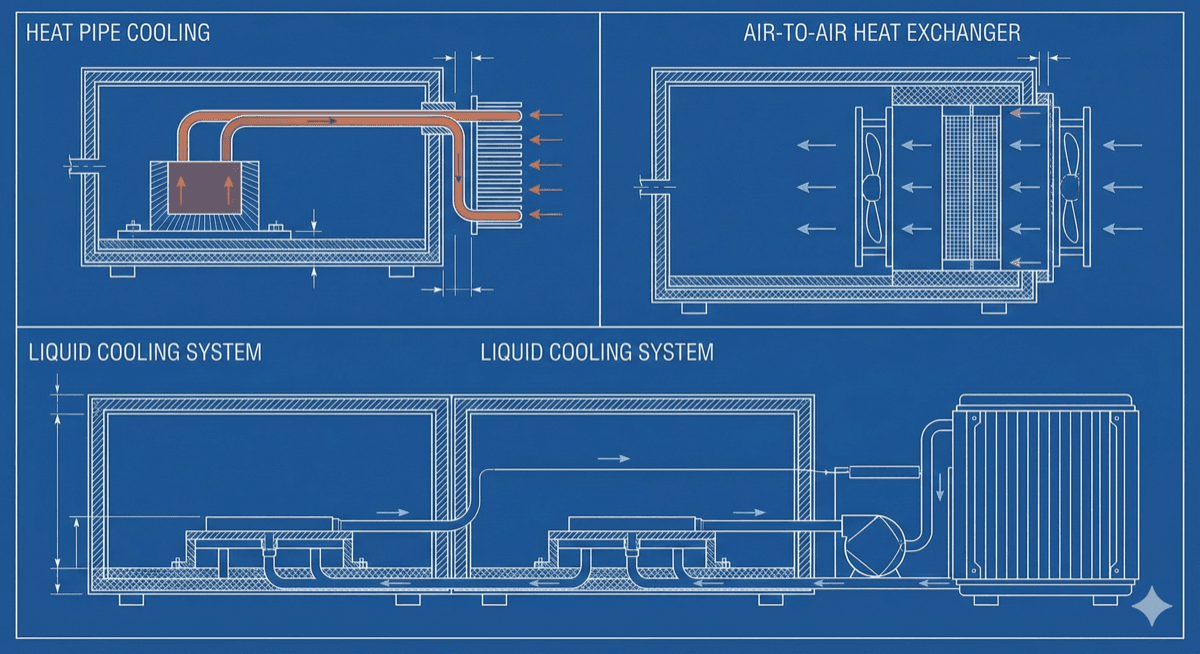
Heat Pipes and Heat Exchangers: Heat pipes can transport heat from internal components to external heatsinks across the enclosure wall while maintaining the seal. Air-to-air heat exchangers provide more capacity for higher heat loads.
Filtered Ventilation: IP5X (dust protected) allows some airflow through appropriate filters. This enables forced-air cooling while limiting dust ingress. Filters require periodic replacement and add maintenance burden.
Vortex Cooling: Compressed air vortex coolers provide significant cooling capacity with no moving parts and can maintain IP66 when properly installed. They consume compressed air, so only practical where plant air is available.
Liquid Cooling: Bringing coolant in and out of sealed enclosures through sealed fittings maintains IP rating while providing excellent cooling capacity. This is the preferred approach for high-power-density equipment in harsh environments.
Air Conditioning: For heat loads exceeding 500W in sealed enclosures, enclosure-mount air conditioners provide the most straightforward solution. They add cost and create another maintenance item but enable consistent internal environment regardless of ambient conditions.
Testing and Certification
IP ratings must be verified through standardized testing:
Dust Testing (First Digit):
- IP5X: Enclosure is placed in a dust chamber with talcum powder circulated for 8 hours. Limited dust ingress is permitted provided it doesn't affect operation.
- IP6X: Same test, but no dust shall enter the enclosure.
Water Testing (Second Digit):
- IPX4: Water splashed from all directions using oscillating spray nozzle, 10L/min, 5 minutes.
- IPX5: Water jet from 6.3mm nozzle at 12.5 L/min, from 3m distance, 3 minutes total across all surfaces.
- IPX6: Powerful water jet from 12.5mm nozzle at 100 L/min, from 3m distance, 3 minutes total.
- IPX7: Immersion in 1m of water for 30 minutes.
Testing Considerations:
- Tests are conducted on complete enclosures with all components installed
- Cable glands must be fitted with representative cables
- Filters, vents, and breathers must be installed as in production configuration
- For certifications like UL, tests must be performed by accredited laboratories
- IP ratings can change with orientation—verify for actual mounting position
Documentation Requirements: For certified products, maintain test reports documenting:
- Test laboratory and date
- Product model/configuration tested
- Test conditions and procedures
- Results and any findings
- Certificate or declaration of conformity
Design Guidelines by IP Rating
Practical design requirements vary significantly by target IP rating:
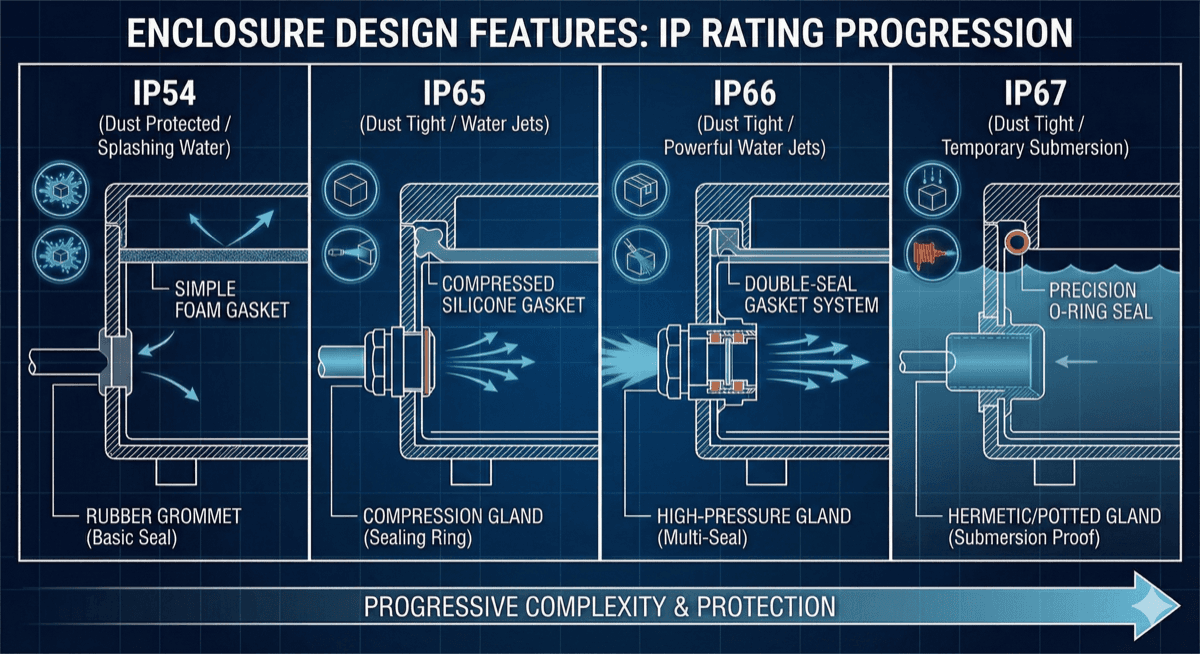
IP54 (Dust Protected, Splash Resistant):
- Basic gaskets around door/lid interfaces
- Standard cable glands
- Ventilation allowed through protected openings
- Drain holes at bottom of enclosure permitted
- Relatively forgiving of surface finish and tolerances
IP65 (Dust Tight, Water Jet Resistant):
- Continuous gaskets on all opening interfaces
- IP65-rated cable glands (compression type)
- No direct ventilation openings—use protected vents or sealed cooling
- Mounting feet should drain water away from seal areas
- Good surface finish required on sealing surfaces (Ra 3.2μm)
- Careful attention to corner details and gasket terminations
IP66 (Powerful Water Jet Resistant):
- All IP65 requirements plus:
- Double lip seals or increased gasket compression
- Cable glands rated IP66 or higher
- More robust seal designs at corners and joints
- Consider redundant sealing at critical interfaces
- Pressure equalization breathers strongly recommended
IP67 (Temporary Immersion):
- All IP66 requirements plus:
- Seal designs must handle hydrostatic pressure
- Cable glands rated IP67 or higher (often sealed types)
- Mounting hardware must not create leak paths
- Consider gasket materials with low compression set
- Design for pressure testing during production
Each step up in IP rating increases design complexity and cost. Specify the rating actually required by the application rather than defaulting to maximum protection.
Maintaining IP Rating Over Product Life
Achieving an IP rating in the lab is one thing; maintaining it over 10-15 years of field service is another:
Gasket Degradation: All elastomers degrade over time due to UV exposure, ozone, temperature cycling, and compression set. Design with appropriate safety margin:
- Use UV-resistant materials (EPDM, silicone) for exposed applications
- Specify compression set limits and verify supplier compliance
- Consider gasket replacement as a maintenance item for long-life products
- Avoid permanent deformation by limiting initial compression
Hardware Concerns:
- Use stainless steel or properly plated fasteners to prevent corrosion
- Apply thread-locking compound to prevent loosening from vibration
- Torque specifications are critical—under-torqued fasteners cause leaks, over-torqued fasteners damage gaskets
- Consider captive fasteners to ensure consistent re-assembly after service
Environmental Factors:
- UV exposure degrades plastics and some gasket materials
- Temperature extremes can cause differential expansion that compromises seals
- Salt spray accelerates corrosion of fasteners and sealing surfaces
- Biological growth (mold, algae) can compromise seals in humid environments
Maintenance Protocols:
- Document seal inspection as part of preventive maintenance
- Train service personnel on proper closure techniques
- Stock replacement gaskets for products with extended service life
- Include torque specifications and sequence on service documentation
Field Validation: For critical applications, consider periodic IP testing of field-returned units to verify sealing performance is maintained throughout product life. This provides valuable data for improving future designs.